Showing posts with label Gender/women/feminism. Show all posts

Thursday, 12 May 2016

Fashion

I don't think I could be called fashionable by any stretch of the imagination, but having new clothes is always a nice feeling - unless you let yourself think about suffering and exploitation which goes into so much clothing production and 'fast fashion' nowadays.  There are some lovely ethical brands (eg. http://www.peopletree.co.uk/), but it's amazing that, on the whole, we are all so complacent about this issue.  Indifference and fashion go hand in hand - in many ways, apathy seems to be the prerequisite of fashion.

Dress by People Tree - http://www.peopletree.co.uk/women/new-in/rhonda-dress-in-green


Tragedies in clothing production occur on a fairly regular basis (eg. the Rana Plaza disaster), quite apart from the daily misery of conditions in many factories - but fast fashion only needs to nod vaguely towards their responsibilities and most people seem to be satisfied.

I'm reading a lot of fourteenth- and fifteenth-century sermons at the moment (this is for my project on nostalgia in the fourteenth century).  It isn't a huge surprise to find the preachers  fulminating against contemporary fashions, revealing necklines, fancy jewellery and so on (usually with a good dose of misogyny thrown in) - in their view, the growing obsession with finery and fashion seemed to embody pride and avarice.  But I was a little more surprised to find their critique also turning to the implications of the production of this clothing.

The early fifteenth-century preacher, San Bernardino of Siena passionately told the crowd, 'were you to take one of these gowns and press it and wring it out, you would see, gushing out of it, a human being's blood.'

Most of San Bernardino's fiery rhetoric would do us little good today - quite the opposite - but on this issue, his combining of anger and compassion might stir us in the right direction.

Monday, 18 April 2016


Prudence inquired, "Have I done too much?" and enthusiasm or compassion, "Might I not, perhaps, have done more?

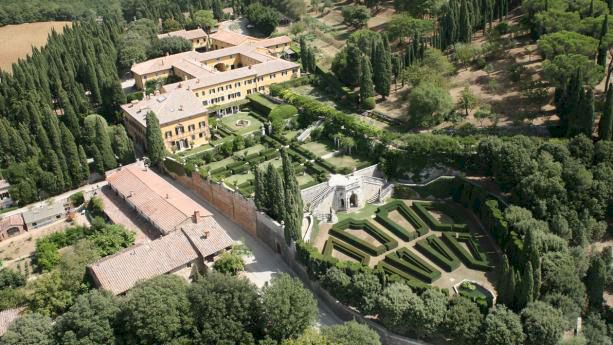
I'm reading the autobiography of Iris Origo at the moment.  She was a fascinating woman, born in 1902 to an aristocratic Anglo-Irish mother, and a father from the mind-bogglingly wealthy New York Cutting family.  After the death of her father from tuberculosis, she was brought up by her mother in the Florentine Villa Fiesole.  She married an Italian aristocrat, Antonio Origo, and they bought a vast estate near Siena, called La Foce, which they restored with gardens designed by Cecil Pinsent.

Iris Origo: source https://www.librarything.com/author/origoiris


During World War II, Iris and her family sheltered refugees on their estate, and she established a model farm, model school and hospital at La Foce for the tenant farmers.

La Foce: source, http://www.montepulciano.net/la_foce_iris_origo.htm#.VxVejfkrLIU


Iris Origo was also a rather interesting historian.  She wrote several biographies and works of history, and I came across her first because of an article in Speculum 1955 entitled 'The Domestic Enemy: The Eastern Slaves in Tuscany in the Fourteenth and Fifteenth Centuries'.  It's a very stimulating article, amassing a good deal of archival material about late medieval slavery, and showing how owners both exploited, and were terribly afraid of, their slaves.  She is perhaps most famous for her book, The Merchant of Prato, about Francesco Datini, a fourteenth-century merchant who left the most extraordinary archive of around 153 000 documents.


I'm enjoying getting to know the woman, as far as one can, through her autobiography - and learning about her extraordinarily privileged, and rich (in every sense) life.  Some of her comments are very much of her time, some of them appal me slightly, and some resonate in such a way that I would just love to have met her.

In her personal diary, she wrote that the challenge of life:

'arose from a continual necessity to weigh in the balance not courage and cowardice, or right and wrong, but conflicting duties and responsibilities equally urgent.... At the end of each day prudence inquired, "Have I done too much?" and enthusiasm or compassion, "Might I not, perhaps, have done more?"'

Tuesday, 24 November 2015

ADA LOVELACE

One of the joys of being on leave is that I am able to stop and look - whether it be following up a particularly intriguing footnote, or having a look round an exhibition in the Bodleian on my way to the library.  In a normal term, everything is so busy that I feel constantly on the back foot.  Anyway - this partly explains the fairly random nature of my interests in blog posts at the moment - I'm doing my 'proper research' honest! but I'm also enjoying my wider interests.

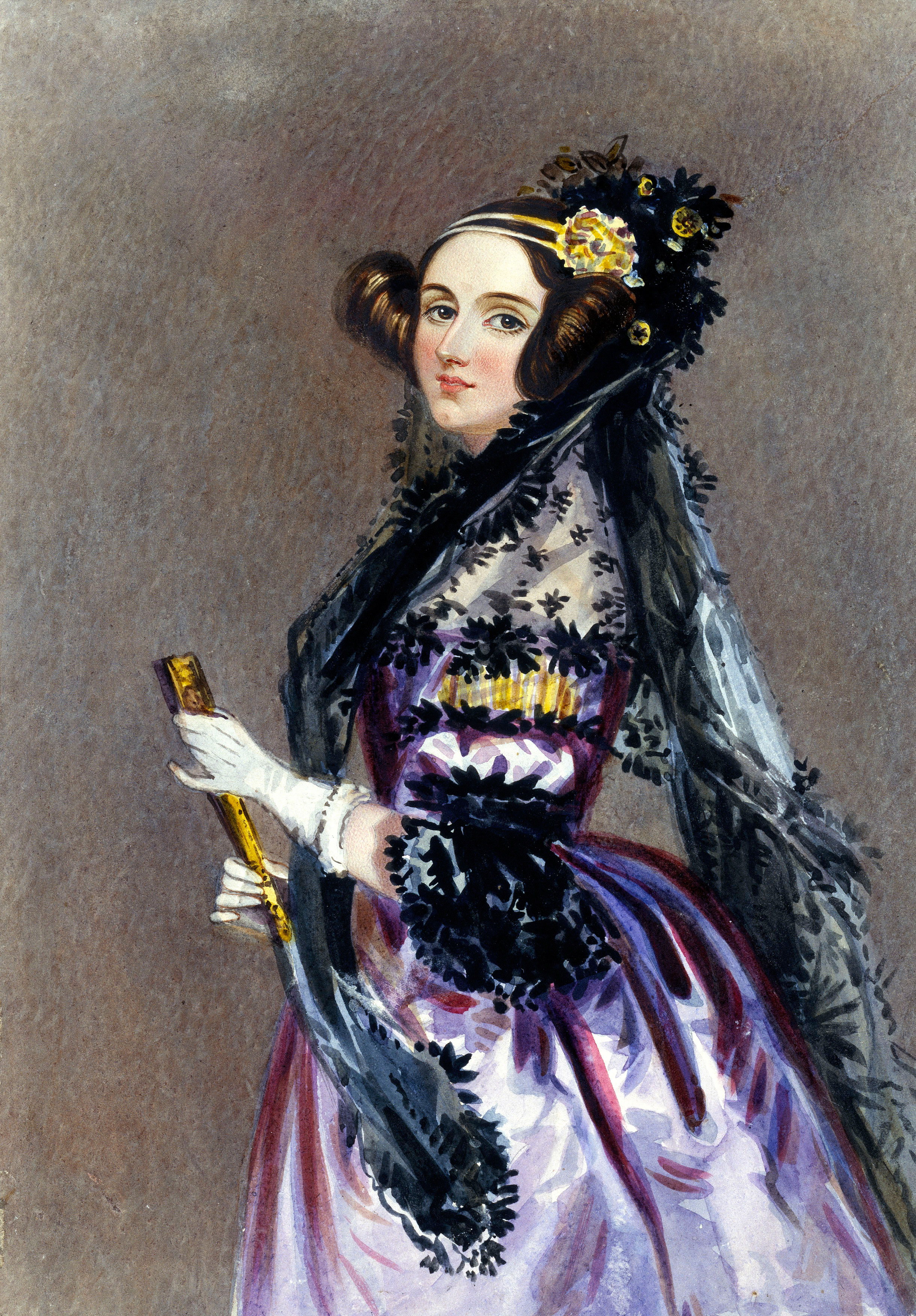
Anyway - there's a small exhibition in the Weston library part of the Bodleian at the moment, on Ada Lovelace.  She's being celebrated at the moment for her role in the history of computing - 2015 marks the 200th anniversary of her birth.

Ada Lovelace, by Alfred Challon.  Source: wikimedia

In many ways, she is an inspiring female figure: Ada Lovelace day celebrates this.  She was the daughter of Lord Byron, and clearly came from a very privileged background.  But she used the opportunities available to her, and pursued her interests with real tenacity.  Added to this, she was *extremely* clever - the Bodleian code displays a part of her paper of 1842, where she translated an Italian article on the 'Analytical Machine' by Luigi Menabrea, and added her own elaborate calculations.   Many describe this as the first computer programme.

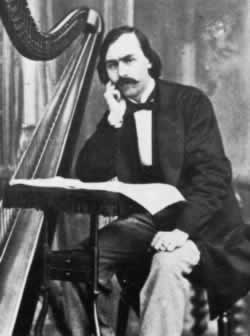
But I had heard of Ada Lovelace in a completely different context.  I have known her as the patroness of John Thomas, a Welsh harpist born in 1826.  He started life as a triple harpist (the triple harp is the traditional Welsh harp, with three rows of offset strings - the outer two rows identical, and the inner row chromatic).  Ada Lovelace made it possible for Thomas to attend the Royal Academy of Music, and there to become an outstanding classical harpist as well.

Image source: http://www.adlaismusicpublishers.co.uk/pages/harpists/john_thomas.htm

John Thomas is an intriguing case of someone who crossed boundaries musically, and whose music nicely embodies 'hiraeth' and nostalgia.  Many of his pieces are dedicated to Ada Lovelace, and although he composed mostly in a classical idiom, he continued to embed Welsh melodies in his pieces, and to devise ways for the classical harp to mimic the particular effects possible on the triple harp.  For example, if you pluck the same tune but slightly out of sync on the two outer rows of a triple harp, you get a mysterious bell-like effect.  Thomas' pieces for classical harp often include harmonics played with the left-hand, so that the notes sound an octave higher, followed in rapid succession by the same tune with the right hand - the effect is similarly other-worldly.  Here's a recording of 'The Minstrel's Adieu to his Native Land' - you can hear the bell effect in the third variation.  To my mind, this is musical longing and nostalgia quite literally figured in the music as one instrument is made to mimic another.

Thomas' music is often set on harp exam syllabuses since it is technically quite rigorous.  It's also quite lovely, and the role of Ada Lovelace, great mathematician, mother and model of determination, is very pleasing.

Monday, 16 November 2015

WOMEN AND HARPS

Tangential connection to previous post: harps.  I've played the harp for about 25 years now.  I think that I chose it originally partly because of Welsh connections, but mostly just because I loved it.  It's a wonderfully responsive instrument to play.

(source: Wikipedia)

I come across harps quite a lot in the sources for the later Middle Ages.  There are plenty of examples of enthusiastic aristocratic harpists, not least among them, Henry V: Malcolm Vale has found receipts for payments for new strings, and eventually for a new harp for the king.  There are examples of medieval women who played the harp (Valentine Visconti played the harp, and accounts for the repair of her two instruments survive; Charles VI of France's daughters Isabelle and Catherine both played the harp; the fictional Isolda played the harp) and there are a few hints that it was deemed to be an appropriate instrument for young ladies: in the early fourteenth century, Francesco Barbarino said that the harp was 'appropriate for a great lady'.  More commonly though, the instrument seems to have been most popular amongst young men.  My favourite reference to a medieval harp comes in the tale of Aucassin and Nicolette, a twelfth/thirteenth chante-fable (a sung, verse story) about a young nobleman and his particularly feisty young lover.  At one point, Aucassin, berated by Nicolette's adoptive father, says that in any case, he'd rather go to hell, for 'There go the harpers and the minstrels and the kings of the earth. With them will I go, so I have Nicolette my most sweet friend with me'.  (Incidentally - it's the most brilliant and intriguing story - crossing gender and racial boundaries in intriguing ways).  Hell sounds a lot more fun - and harps are most certainly not associated with heavenly angels, but with hedonism, masculinity and hell.

So when did the harp become so feminised?  I should add straightaway that it isn't entirely feminised - many of the classical music world's most wonderful harpists are men (eg. Xavier de Maistre; Emmanuel Ceysson).  And in Wales, where Henry V's interest in the harp may well have come from, there is little sense that this is a particularly female instrument.

I have just read an extremely interesting article by Hannah Lane (Cerae 1, 2014), which provides a rather convincing answer to this question.  She discusses the introduction of the single-action mechanism in around 1720 (for harp nerds, these innovations are absolutely fascinating - harp-makers have always had to find solutions to enable the production of semi-tones on the harp, and the single-action pedal mechanism, succeeded by today's double-action pedal mechanism, is one solution).  These new harps were more dynamically expressive, and the new chromatic possibilities led to a whole new repertoire which focused on the Empfindsamer style, which privileged emotional sensitivity.  The single-action mechanism made possible, in particular, rapid or continuous arpeggiation - probably now the sound most associated with the classical harp and alternately tender or delicate, and stormy.

And this was a moment at which this kind of emotionalism was being more explicitly associated with femininity.  To weep sweetly was women's work.  An entry in Diderot's Encyclopedia in 1767 claimed that the single-action harp 'has become an object of amusement for the sensitive sex, who, far from depriving themselves of the emotions that the harp can excite in our souls by it sweet harmony and mellifluous sounds, lend to it even more favourable assistance in order to increase its charm' (Lane, p. 82).  Emotional expression is clearly gendered in particular ways in particular periods, and to find that such labels might have shaped a long-standing perception of a musical instrument is very striking.

A concert grand pedal harp now holds about two tonnes of tension in the strings, and is capable of an enormous dynamic range.  But throwing off the rather vapid 'feminine' associations is a slower process.  The harp is not an instrument for lacy frocks, but powerful and expressive and as interesting and many-faced as we know gender to be.

If I were a millionaire - I would buy the Salvi scolpita... (image source: salviharps) - although this seems a little disloyal to my own harp, the unoriginally named Orpheus 47 - it's a Japanese Aoyama harp, made of maple, and with a lovely bright tone.


Monday, 20 October 2014

OSCAR AND LUCINDA

I've just finished reading Peter Carey's Oscar and Lucinda, a marvellous sweeping book, which is both quirky and perceptive, horrifying and extremely funny - it's really quite unlike anything else I've read.

http://www.themanbookerprize.com/books/oscar-and-lucinda


Near the beginning, we are introduced to the character of Mrs Stratton, a late Victorian clergyman's wife, living a life of disillusionment and poverty.  Her husband went to Oxford - Mrs Stratton, obviously, didn't.

'Mrs. Stratton was not a don.  She could not have been, for while the constitution of the university would permit entry to a fourteen-year-old boy (with his pocket full of string and dried-out worms) it could on no account matriculate a woman.  Yet Mrs Stratton had the walk for it.  Her whole body expressed her calling.  She had a walk you can see today in Magpie Lane and Merton Street.  The dynamics of this walk are best appreciated if you place a three-foot-high stack of reference books in your imaginary walker’s extended arms.  From here on it is all physics.  You can resolve it with vectors – the vertical arrow indicating the mass of the books, the horizontal one the propulsive force of the moving body.  It is obvious.  You can see immediately why the body of such a person tilts forward at 60 degrees to the horizontal.  It is the books, or the propensity for books, that does it.  And when you see the height of the stack it is also clear why such people always lift their head so high.  You thought it was myopia, but no – it is the height of the imaginary books they must look over.'

It's an unkind description, although the narrator is not a gratuitously cruel one.  But the unkindness exposes the mistrust and antipathy towards women with intellectual pretensions.

Anyway - I hope I don't walk like this!

Tuesday, 16 September 2014

SLAVERY 14 - WASHING LINES

One of my favourite things about cities like Dubrovnik and Venice is the lines of washing hanging high above the narrow streets or perilously waving in the breeze above the canals.   It's a nice reminder that these tourist-saturated cities still have domestic lives, and that despite the extreme special-ness of these places, they are still enveloped in the everyday.


The vast majority of slaves in the documents I have looked at are described as 'ancillae'.  These are slave girls.   I'm certainly not the first person to notice that much late  medieval slavery was domestic and female - these were girls bought to get on with the everyday chores which form the bedrock of even the most magnificent city.


Equally it's quite surprising that, although there are examples of slaves used in shipping and more heavy labour, areas which we might expect to have been quite heavily dependent upon slave labour seem to have been contracted in a much more conventional manner.  The magnificent walls of the city, for example, do not seem to have been constructed by slaves, but by paid labourers.  There are contracts with stone-masons (Diversa Notariae 33, fols. 185-6), with surveyors (Diversa Notariae 35, fol 93), and so on.


This isn't to say that there weren't male slaves, but it is nevertheless striking that slavery was largely a female phenomenon (at least in the first part of the period).  I've been looking also at the kinds of contracts whereby people effectively sold themselves (or, often their children) for a set number of years.  Some of these contracts see in practice to be like apprenticeships, with the purchaser of the labour committing himself not just to feed and clothe the  person, but to educate them in a particular trade or skill (eg. goldsmithery or apothecary).  These aren't exactly apprenticeships - they're described still as the sale of labour for however many years - but one can see the appeal for  those struggling with poverty.   And they are all for boys.  There are similar contracts for girls - but, although in most ways absolutely identical in wording, surprise surprise, the contracts for girls involve nothing but domestic chores and doing the will of the 'owner' and whatever he should ask.


Thursday, 28 August 2014

WOMEN AT ST JOHN'S

St John’s College is currently celebrating ‘2000 WOMEN’: in October 2013, the 2000th woman matriculated to study here.

I was asked to produce a little sound-bite to celebrate this: you can see it here.

It wasn’t quite the appropriate context (nor did I have enough words) to say that, as far as I can see, there were actually three ways for women to be involved in medieval universities:

1/ as patronesses (Margaret of Anjou, one of the foundress’s of Queen’s College, Oxford, claimed the establishment was for the ‘laud and honneure of sexe femenine’)

2/ as prostitutes

3/ as launderesses

And sometimes as nos. 2 and 3 together.  So not only were women excluded, but they reduced and objectivised in pretty basic ways.

Margaret King has pointed out that there were a few female humanists in the fifteenth century, but they tended to be daughters of prominent humanists, educated by their fathers.  Given the desired celibacy of medieval university masters, even this informal educational opportunity was denied to women in university towns.


I would love to be able to find ways in which women could be informally involved in university learning in the Middle Ages, but I fear that this is unlikely.  So, I will reiterate my sound-bite: women, now is your moment!


Saturday, 29 March 2014

Christminster

I've just finished reading Jude the Obscure by Thomas Hardy.  I'm working my way through Hardy's novels mainly because we spent so much time in Dorset last summer: the sense of place and way in which the landscape acts on the individuals is very striking in Hardy's writing.


Jude the Obscure is depressing and dispiriting and quite astonishingly horrific.  Much of the plot revolves around the idea of what constitutes true marriage, and the place of sex within it - I was pretty struck to find such frank discussion of sex in a book published in 1895.  The multiple tragedies of the plot are shocking and awful beyond words really - and Hardy seems quite deliberately to avoid encompassing the full horror in language, offering only short and abrupt accounts of the climactic moments.

Despite the romantic and familial tragedies which hit Jude, in a sense it's his own unrealistic aspirations which utterly destroy him.


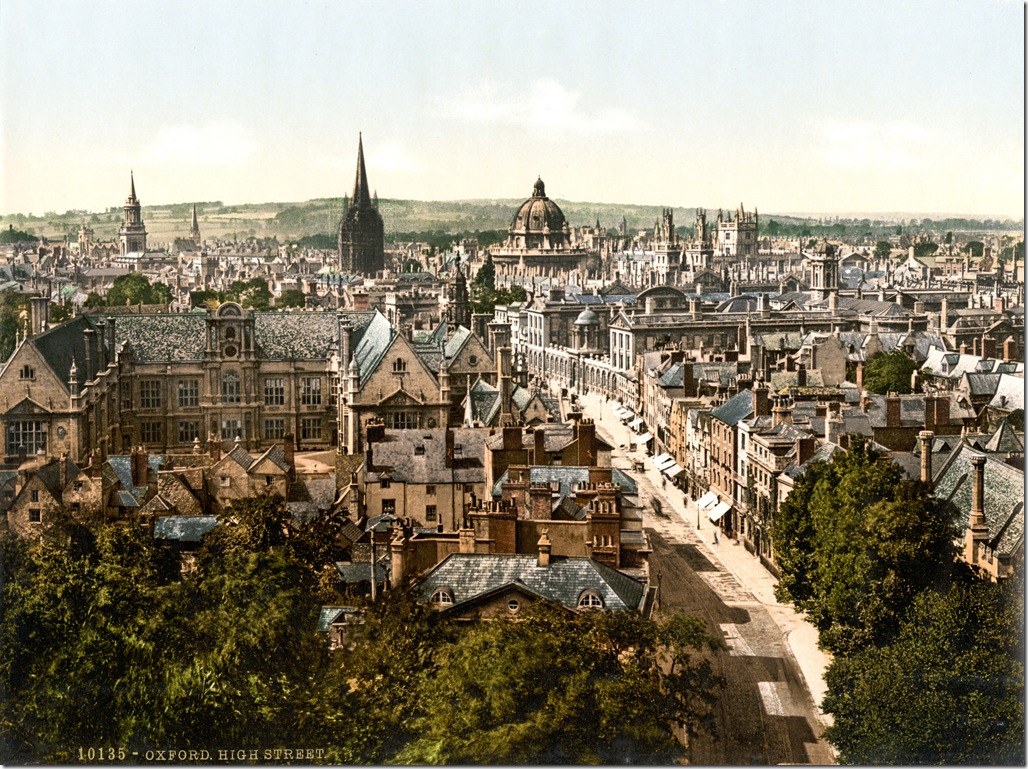
As a child, he becomes obsessed with the idea of studying at 'Christminster' - a university town, very much like Oxford.  For Jude, it's a highly romantic place - characterised by the eminence of a tradition of learning stretching back to medieval times, the peace and tranquillity of lives dedicated to the pursuit of learning, the centuries-old architecture a moving witness to the intellectual achievements which have happened within its walls.  But those very walls, on which he ends up working as a stone-mason, symbolise his exclusion - for no other reason that his social status and background.  The reader knows, with a sense of pathetic inevitability, that Jude's hopes and dreams, and endless nights spent self-teaching, are utterly in vain.  And not only does this make a tragedy of Jude's life - it makes a mockery of learning and all it apparently stands for.

'He always remembered the appearance of the afternoon on which he awoke from his dream. Not quite knowing what to do with himself, he went up to an octagonal chamber in the lantern of a singularly built theatre that was set amidst this quaint and singular city. It had windows all round, from which an outlook over the whole town and its edifices could be gained. Jude's eyes swept all the views in succession, meditatively, mournfully, yet sturdily. Those buildings and their associations and privileges were not for him. From the looming roof of the great library, into which he hardly ever had time to enter, his gaze travelled on to the varied spires, halls, gables, streets, chapels, gardens, quadrangles, which composed the ensemble of this unrivalled panorama. He saw that his destiny lay not with these, but among the manual toilers in the shabby purlieu which he himself occupied, unrecognized as part of the city at all by its visitors and panegyrists, yet without whose denizens the hard readers could not read nor the high thinkers live.'

Oxford.  Image credit: http://psychogeographicreview.com/?p=2014


This all made for quite uncomfortable reading for me, happily ensconced in the honey-coloured quad of St John's.  I truly don't think that the same comments could be made of Oxford today - but the danger is always there that we become so absorbed in tradition and self-congratulation, that we fail to ensure that the university offers opportunities to as many as possible, regardless of background; in welcoming people to the university - to research, to learn and to teach - all our own minds are opened by the insights and contributions which come together.  And this is why study days for A-level students, like the one we held last week, are so important - so thanks to everyone who came!

Monday, 24 March 2014

The streets of Paris


The other purpose of this trip to Paris was to get a sense of the space used by students when misbehaving in the fifteenth century.  My project is a comparative one, looking at Oxford, Paris and Heidelberg.  Then, as now, these were three very different cities, and exploring the different ways in which students engaged with the urban space in which they found themselves, provides some useful points of contrast.

The buildings in Paris have, for the most part, changed dramatically since the fifteenth century.  But a lot of the street layout in the Quartier Latin, where the students lived, remains remarkably similar.  I have found quite detailed accounts in the archives of how students negotiated their way around the streets and squares, and used the different connotations of particular areas to give meaning to their mischief.  


So, for example, we learn that in 1470, one Master Hugues Angot was woken from sleep in his hostel in the Rue des Noiers (now absorbed into the Boulevard Saint Germain) by loud and insulting singing outside his window.  Unable to sleep, and unable to endure the insults to his masculinity, and knowing the perpetrators to be old rivals, he roused his friend and they both went out into the street in their nightgowns.  They walked as far as the corner of the Rue des Anglais, but couldn’t see their disturbers, so they went back inside to get dressed properly.  Then they went out again, and saw their enemies at the end of the rue du Plastié (now rue Domat).  Unwilling to confront them directly, they passed on to the Place Maubert, a small square lined with student hostels and brothels.  Then they decided to take the long way round back to their hostel to avoid being spotted by their enemies and to avoid provoking a fight.  So, they passed by rue des Lavandières, then Rue des Noiers, then the Rue des Anglais.  Then turning down the Rue du Plastié again, they returned to their hostel via the Rue Saint Jacques.  But, just as they were returning to their hostel, they saw their enemies coming from the Rue des Anglais.  At this point though, some other people appeared, so the aggressors fled to the corner of the Rue des Closbrimeaux (now Rue Jean-de-Beauvais).  The men who’d been woken then chased their enemies until the Place Maubert, where they caught up with them outside the tavern des Trois Haches.  At this point the insulting singer tried to hit Hugues Ansot on the head, but Hugues defended himself with a stone, and the man was killed.
 

Not realising this, Hugues returned to his hostel.

At least this is the account which Hugues gave in his appeal for remission for murder.  Self-consciously trying to justify himself, he referred to space in very particular ways.  Retracing the steps of these students gave me a real sense of the importance of space.  Strategically, the students moved between the great open space of the Rue Saint Jacques and the overcrowded, dark spaces of the narrow streets of the Quartier Latin.  And symbolically, they moved between the public spaces of the city and the spaces of student and university life – they were making points about their integration into the life of the city, about the defence of their honour.  The real sense of their movements, the scary nature of events, the way in which their actions were shaped by, and shaped, the space around them – felt very different as I walked along the cobbles. 


Friday, 21 March 2014

In the archives

I’ve just returned from a wonderful trip to Paris (thanks to Frédérique Lachaud and the séminaire Franco-Britannique for the invitation) and this seems like a good moment to try to start posting again on the blog… sorry for the massive hiatus!

As well as getting some great feedback on my work on fifteenth-century student misbehaviour from colleagues at the seminar, and spending some time showing my son and husband my favourite spots in Paris, it was an opportunity to go to the archives and gather some more material on the fifteenth-century University of Paris. 


I always get a little anxious before these trips that so much of the material I work on is published and available in wonderful and scholarly editions, that it is hardly worth looking at the originals.  This is emphatically not true!  Every trip reminds me that there is so much still to discover (a trip to Heidelberg over the summer was crucial in discovering that the Acta universitatis, the main records of the university, continue for years after 1451, the end date of the published edition), and, of course, there are often inaccuracies in the published editions.  

But going to the archives represents something more than this I think – something more intangible.  It’s partly to do with a sense of historical imagination – holding a 600 or 700-year-old document in your hand gives a sense of connection with the past which is inspiring.  It’s partly to do with getting a real sense of the size, quality and format of the documents to underline the purpose they were designed to serve.  And it’s also to do with the fact that these aren’t just documents with text – they’re objects in their own right.  In many ways, some of them were even historical agents of sorts.  The point was brought home to me particularly forcefully when I was working in the archives in Lille in northern France some years ago.  I was looking at evidence for a revolt in Saint Omer in 1306, and found that the rebels were much inspired by a letter written to them by a famous Flemish rebel named Peter Coninck (who had led Flemish weavers to victory in the Battle of the Golden Spurs) – whilst the letter provided inspiration for its recipients, it was discovered by their enemies who used it further to discredit them.  The letter itself became almost fetishized – it ceased to matter what it said in it – it was fought over and talked about and grabbed and stolen – the letter itself came to symbolise the protest and the struggle.  To see the document itself then, was to see not just a document which told me about the revolt, but something which had been part of the revolt itself.  A much more comical example is that of a quittance or receipt sent to the Count of Artois in the late 13th century – - it was sent from the court jester, known as ‘Fromage’, and the rather disgusting remains of his seal – a punning bit of cheese – linger greasily on the parchment.  Another example of a document which was something much more than a piece of writing – it was part of a historical process, a joke.
  

Wednesday, 9 October 2013

TERM STARTS

Term is getting started, and it's a great treat to meet the incoming students and to see our second and third years again.  I must confess to being quite nervous about fitting everything in this term - it will be a challenge, but an exciting one I think.


Managing childcare during term-time is a particular challenge, as the flexibility of my research-time whilst the students are away is now a thing of the past.  And I'm struck by the number of comments from the rich and famous about how they face exactly the same problems.  I'm sorry - but they don't.  Having vast financial means makes things different.  Having the possibility of providing everything for your child makes things different.  And whilst I'm in a completely different world from these celebrity mothers, I should not pretend to be remotely facing the same problems and challenges which confront those in deprived parts of society.  It's nice to try to empathise, but I think it's not just misleading but regressive.

Victoria Beckham apparently recently commented: 'I'm basically just like any woman who's working and has lots of children - it's tough'.  Of course she isn't.  And she can't possibly know whatit's like to work because you have to financially, to struggle to afford childcare as well as working, to rush from pillar to post so that you're in the right place at the right time.  By suggesting that she does understand, she minimises the problems faced by many other mothers, and draws a veil over the need for change.  I can't possibly understand the challenges faced by mothers in many of the poorer parts of Oxford, and it would be insulting to claim that I can.  We need to acknowledge the vast inequalities before we can do anything about them.

I was also irritated by an article in the Guardian a while ago, claiming that Kate Middleton would face the same indignities during childbirth as everyone else.  This is idiotic.  Having the best medical attention that money can buy, a private suite, and the support of a loving family is not the same as giving birth without medical help on an earth floor somewhere.  I have personal reasons for feeling particularly strongly about this, given some pretty appalling medical care I received when having my own son - glossing over this and suggesting that we're all in it together is profoundly unhelpful.  It's a way of pretending that social and economic divisions don't meaningfully matter, and an insidious way of claiming that we don't need to do anything about them.

In the Middle Ages, there was certainly very little suggestion that the rich could empathise with the concerns of the poor, and nor were there attempts to claim that royals were 'just like us really'.  Social inequalities in the Middle Ages were truly appalling, but refusing to gloss over the gaps was a first historical step to acknowledging them, and, centuries later,to attempting to do something about them.  It will be very sad if we now fall for the pretence that they don't exist after all.