Showing posts with label Places. Show all posts

Monday, 18 April 2016


Prudence inquired, "Have I done too much?" and enthusiasm or compassion, "Might I not, perhaps, have done more?

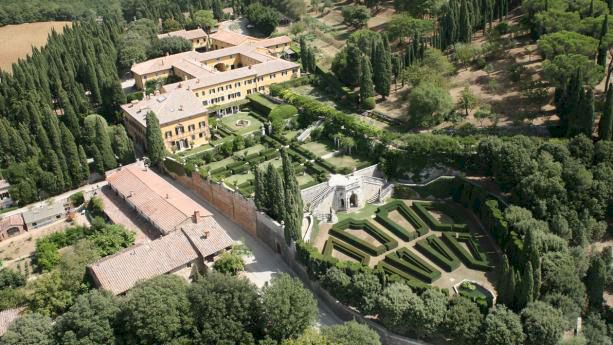
I'm reading the autobiography of Iris Origo at the moment.  She was a fascinating woman, born in 1902 to an aristocratic Anglo-Irish mother, and a father from the mind-bogglingly wealthy New York Cutting family.  After the death of her father from tuberculosis, she was brought up by her mother in the Florentine Villa Fiesole.  She married an Italian aristocrat, Antonio Origo, and they bought a vast estate near Siena, called La Foce, which they restored with gardens designed by Cecil Pinsent.

Iris Origo: source https://www.librarything.com/author/origoiris


During World War II, Iris and her family sheltered refugees on their estate, and she established a model farm, model school and hospital at La Foce for the tenant farmers.

La Foce: source, http://www.montepulciano.net/la_foce_iris_origo.htm#.VxVejfkrLIU


Iris Origo was also a rather interesting historian.  She wrote several biographies and works of history, and I came across her first because of an article in Speculum 1955 entitled 'The Domestic Enemy: The Eastern Slaves in Tuscany in the Fourteenth and Fifteenth Centuries'.  It's a very stimulating article, amassing a good deal of archival material about late medieval slavery, and showing how owners both exploited, and were terribly afraid of, their slaves.  She is perhaps most famous for her book, The Merchant of Prato, about Francesco Datini, a fourteenth-century merchant who left the most extraordinary archive of around 153 000 documents.


I'm enjoying getting to know the woman, as far as one can, through her autobiography - and learning about her extraordinarily privileged, and rich (in every sense) life.  Some of her comments are very much of her time, some of them appal me slightly, and some resonate in such a way that I would just love to have met her.

In her personal diary, she wrote that the challenge of life:

'arose from a continual necessity to weigh in the balance not courage and cowardice, or right and wrong, but conflicting duties and responsibilities equally urgent.... At the end of each day prudence inquired, "Have I done too much?" and enthusiasm or compassion, "Might I not, perhaps, have done more?"'

Thursday, 12 November 2015

HIRAETH

I was born in Wales, in a small town called Llanrwst.  I'm not really properly Welsh (although my middle name is Haf), but I can still feel 'hiraeth'.

River Conwy at Llanrwst. Source: wikimedia


Hiraeth is a particularly, peculiarly, Welsh feeling.  And it's very hard to translate.  It's sort of yearning.  It's sort of nostalgia.  It's sort of a sweet melancholy.  It's the natural landscape - the mountains and the sea - calling, and it's the longing in response.

Llanrwst.  Source: wikimedia

In my quest for expressions of nostalgia (my new research project - alongside the misbehaving students thing), 'hiraeth' is a really interesting concept.  It's related to, but not cognate with, Portuguese 'saudade', German 'Heimweh' and so on.  The origins of nostalgia as a term lie in the eighteenth century, at which point it indicated a medical condition suffered by those far from home.  Only really in the nineteenth century did nostalgia become a temporal condition, as one looked back to the good old days.  'Hiraeth' is all of these things, as well as a more rooted bitter-sweetness.  It works well in the context of the Welsh diaspora - for instance, there's a wonderful project in Patagonia by the Welsh community there (see here).  But it can also be felt at home in Wales.  And if it's a yearning, it's also a comfort.

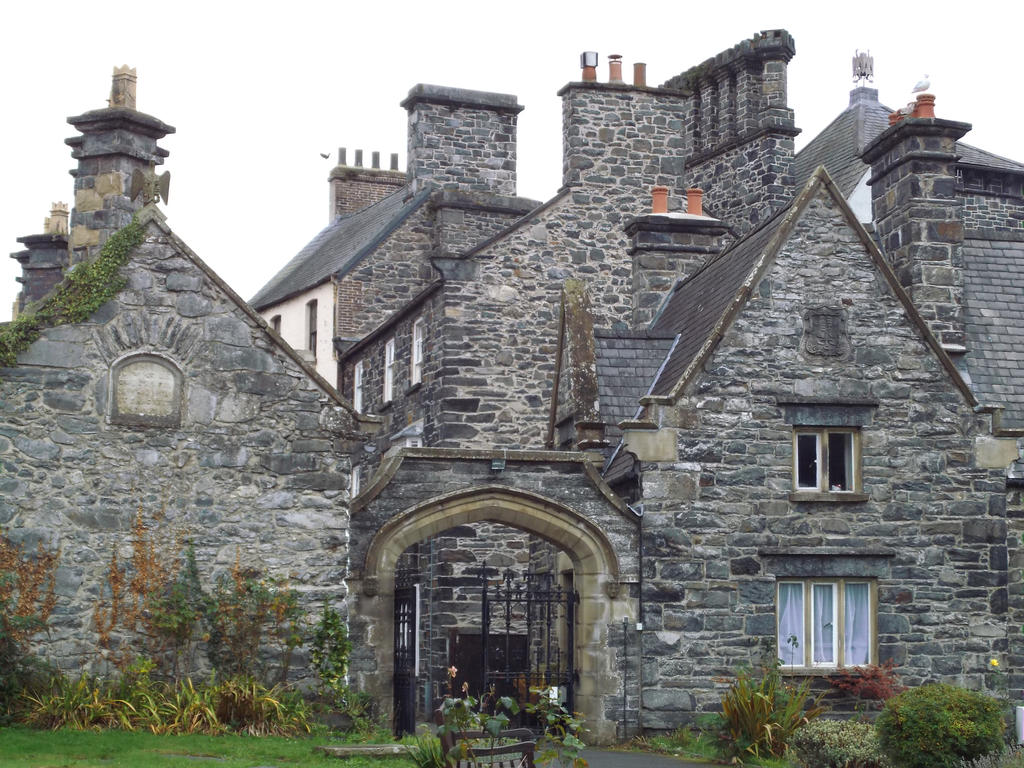
Llanrwst: source (http://www.deviantart.com/art/Almshouses-and-back-of-Eagles-Hotel-Llanrwst-408160317).  The picture is taken from the Churchyard.  We lived in the house on the left; my godparents lived in the house on the right.

This song, by the gentle-voiced Max Boyce, accompanied by Christine Cooper and an amazing triple-harpist, Llio Rhydderch, expresses 'hiraeth' more sweetly and its comfort more eloquently than prose.  It's like a mist stealing over one, a gentle companion.  And, in this, it's a very special form of nostalgia.  Nostalgia looks like a feeling rooted in time (is it really?) - 'hiraeth' transcends time - as the song tells us, it never fades.


'Tell me then, you men of learning
Why is hiraeth more than yearning
Why when darkness minds to hide me,
Hiraeth comes and sleeps beside me?

Gold and silver wear out
Velvet and silk wear out
Every rich garment falls apart,
But longing never fades.


Wednesday, 4 November 2015

LIMBURG

Whilst in Germany last week, we spent a happy day in Limburg (an der Lahn).  It's such a pretty place, complete with cute half-timbered houses and evidence of a rich medieval history.  It lies in a natural settlement spot - this is one of the richest agricultural areas of the Hesse region, and there's a convenient crossing over the Lahn.  I love this river - my parents-in-law live much further upstream, and whenever I take a train from their flat, my journey always begins by following the river as it meanders gently through the valleys.


In 1289, there was a great fire in Limburg, and it looks as though there was then a concerted and rapid attempt to rebuild, so that there are early fourteenth-century buildings which are amongst the earliest of their type in Germany.


 The cathedral is spectacular, and unusually colourful.


The three-year-old's view...


It was a lovely place to visit - partly because it gave me such a nice sense of the vivid colour of medieval life - despite its hardships, this was not a period of monochrome - and partly because the completeness of the squares was so evocative of bustling markets.

And I had the most delicious Flammkuchen for lunch!


Sunday, 25 October 2015

AGINCOURT

Today is the 600th anniversary of the battle of Agincourt.

From the Chronicle of Enguerrand de Monstrelet. Source: wikimedia

Last weekend, I was privileged to speak at a day of lectures on the context and battle of Agincourt.  I had been a bit wary of the activities organised to commemorate the battle, but what made this day so effective, and what has made many of the lectures, exhibitions and activities organised by Agincourt600 so valuable, is the thoroughly nuanced approach which has been adopted.

Part of this has involved detailed research on the numbers of men fighting, wounded and killed; on the weapons used; on the provisioning of the army; and on the siting of the battlefields.  This has been done by examining indentures, inventories, quittances and so on - rather than relying on chronicle accounts where more or less hidden agendas can prove very distorting.   Anne Curry's new book on Agincourt is particularly effective here.  The result is to illuminate what remains an extraordinary battle, but to become more respectful of the suffering involved, and the sheer logistics of the operation.

Part of this has involved setting Agincourt in a far wider context:  the political factionalism in France, arising in the main from a king suffering from paranoid schizophrenia who often believed he was made of glass; the rise of the House of Lancaster in England, with its mighty dynastic ambitions; and the staggeringly talented Henry V.  Malcolm Vale spoke on Henry V, and drew a portrait of a king immensely courageous and skilled at battle strategy, but also pious, concerned for Church reform, careful (he wrote many wills), cultivated and a workaholic.  It all serves to remind us that whilst we might pick out one historical moment, the reality was far more richly textured.  Military activity was one thread in a weave of political instability, economic interests, diplomacy and social dislocation.

Memorial for the battle. Source: wikimedia


And perhaps most strikingly, rather than simply contributing to the myth of Agincourt, the commemorations have shown how this myth arose.  Such is the particular strength of Anne Curry's new book - why has Agincourt in particular achieved such a pre-eminent place in the popular imagination?  Shakespeare is often held responsible for the image of the good king Hal, and the defeat, against all the odds, of the French.  But of course, Shakespeare is a great writer precisely because his work resists a single reading.  He challenges us because he shows that life is an entangled web of perspectives, where easy judgements can mask infinitely complex realities.  And this seems a fitting way to think about Agincourt.


Saturday, 24 October 2015

BORDERS

I'm in Germany right now, and, for the first time we took the train the whole way.  I love train journeys, and so does my son - there's a romance about them, a satisfaction in going almost door-to-door, and a really nice sense that you see the intervening landscape rather than the dislocation that comes from taking off in one place and seemingly magically landing somewhere entirely different.

Hauptbahnhof, Koeln.  Source: wikimedia


My son really flummoxed me on the journey from Brussels: I was busy day-dreaming, when he suddenly asked 'When are we in Germany?'  I suddenly realised that I had no idea which country we were in.  As it turned out, the changing appearance of the houses made it quite clear when we'd crossed the border, but it did remind me just how artificial borders are.  The channel can con us into thinking differently.  It's also a message repeatedly brought home to me by my husband, who is mainly German, was born and brought up in Romania, by a Bulgarian mother and an Austrian father.

There's very little that's natural about borders.  Even when they are marked by physical geography, history shows us that they are mutable and mean different things at different times.  The fourteenth and fifteenth centuries are particularly fascinating in this respect, since they seem to mark two seemingly contradictory trends.  On the one hand, it was during this period that polities began to take on more distinctive identities, both politically and culturally - and borders began to be crystallised.  On the other hand, it's a period of really surprising levels of travel, contact and exchange (the latter two terms forming the title of a collection of essays we edited for Malcolm Vale about precisely this topic).  I think it's really significant that it was the moment at which borders were more clearly visible, that travel and exchange became pretty commonplace.

The refugee crisis means that thinking about what borders mean (and don't mean) is particularly pressing.  Borders often serve a purpose, but it would surely be helpful, and ultimately a bit more humane, if we reminded ourselves regularly that they have complex and shifting histories.  We very nearly missed our connection in Brussels because there were 'trespassers' on the line at Calais.  Thinking about what this really meant, and the assumptions and prejudices on so many levels which continue to generate such situations, is, I think, deeply troubling.

Saturday, 17 October 2015

John Schorne and 'popular religion'.

I've been wallowing in a bit of nostalgia recently.  In a wonderful handling session in the Ashmolean museum, Jim Harris (Teaching Curator) showed us an intriguing little object.  It seemed to show a rather cheerful looking little devil popping out of a boot.  The boot was held by a solemn looking priest.  It was actually a mould for the thousands of pilgrim badges which were produced as little keepsakes for the hugely popular pilgrimages of the later Middle Ages.  The strange little image triggered cascades of memories from 1990, when I was at primary school in North Marston.

My old home.  Source, wikimedia.


North Marston is a small village in Buckinghamshire.  For me, it's the site of idyllic memories playing in the fields, scouring the hedgerows, hearing about ghosts who frequented our spare bedroom, and a very happy little primary school.  At the school, we were divided into three teams: Verney (the Green team, and named after the Verney family of Claydon House); Campden Neild (the Red team, named after a nineteenth-century miser who bequeathed all his fortune to Queen Victoria : she built Balmoral with the proceeds), and Schorne (the Blue team, named after a medieval rector and miracle maker).  Oddly, we seemed to associate particular character traits with each team: the Greens were seen as a bit plodding but straightforward (I was a green); the Reds were a bit showy; the Blues were a bit self-righteous.  Did this have anything to do with some sort of odd unconscious social memory of the characters who gave names to our teams? - probably not, but it's tempting to think so.

John Schorne pilgrimage badge replica: sent to me by the very kind North Marston History Club


John Schorne was rector of North Marston from 1282 until his death in 1314.  He had been a master at the University of Oxford, and we can trace him in the records there.  At that point, North Marston was a poor and fairly unremarkable parish.  One year, there was a terrible drought.  John Schorne banged on the ground with his staff, and water came gushing, miraculously out.  It was said to have all kinds of healing properties, and very quickly, North Marston became an extremely important pilgrimage centre.  People came from far and wide, and the village rapidly became very wealthy.  It explains the large and rather magnificent Church, otherwise strange in a small Buckinghamshire village.

North Marston Church: source, wikipedia


A second legend emerged, that John Schorne had conjured a devil back into a boot.  This became the abiding image of Schorne.  Hundreds of pilgrimage badges were produced depicting this scene, sometimes said to be the origin of the modern jack-in-the-box.  Around 70 of these badges have been discovered by archaeologists.

Image from rood screen at Gateley in Norfolk: source http://www.binhampriory.org/General%20articles/Schorne.html

Such a situation could not last for long.  Richard Beauchamp, Bishop of Salisbury and Dean of Windsor had his eye on the relics.  They were, after all, extremely lucrative.  In 1478, the relics were moved to Windsor, and North Marston reverted to its dependence on farming.

But John Schorne was never officially canonised.  There is no surviving 'Life of John Schorne' and very little written evidence.  But we know that the cult was extremely widespread - there are references from the North of England, and images in Suffolk.  Protestant reformers in the sixteenth century, and Cromwell's men in the seventeenth, were unimpressed, and we have several references to what they perceived as the continued gullibility of people regarding the cult.

The water authorities deny the healing properties of the water.  But not everyone is prepared to accept such a blunt denial.  In 1820, the Gentleman's Magazine published an article on the well and declared that the water had traces of chalybeate, potentially explaining its curative properties for gout.  In a lovely booklet by David Drewett produced for the 700th Anniversary celebrations in 1990, we hear that 'In 1973, several people told me that they had never had a good cup of tea since the well closed'.

I remember the Anniversary celebrations.  At primary school, we made a huge puppet with a devil coming out of a boot - we used to recite over and over 'John Schorne, gentleman born/ Conjured the devil into a boot'.  In 2004/5 the village fund-raised enough money to build a new and fancier cover for it.

The Schorne well: source, wikipedia


Schorne's relics may have been moved to Windsor, but he remains a powerful symbol of community in North Marston.  As a study in social memory, the after-life of his cult is fascinating - he has become a central point of village identity, a rather reassuring symbol of a more frightening struggle between good and evil, and a reminder of the importance of access to water in a primarily agricultural community.  And the well has never run dry.

As historians, we become so reliant on written sources that we are in danger of forgetting the range and intensity of popular religion.  We assume that anything truly significant must have been sanctioned by the proper Church authorities.  But medieval society was so much richer, more complex, more entangled than that.  And when we do acknowledge the importance of 'popular' currents, we tend immediately to associate them with subversion.  But the cult of John Schorne shows that if something is not officially sanctioned, that doesn't automatically make it subversive.  It gives us a picture of wonderful and rich complexity, of the different strands of society weaving together and pulling apart, of the ways in which people actively shaped, and were shaped by, their religious beliefs.

Thursday, 25 September 2014

SLAVERY 18

We're home now.  I miss Dubrovnik already!  What a wonderful time we've had - in every way.  The material I've been looking at will now go on to the back-burner for a while, as I prepare for a term's teaching and return to my main project on misbehaving students in the fifteenth century.

St Vlah (St Blaise), patron saing of Dubrovnik, holding the city in his hands


Tuesday, 23 September 2014

SLAVERY 17 - THE MORAL AND THE LEGAL


The starting point for my interest in slavery arose from trying to think about notions of property and ownership from the perspective of legal anthropology.  In this sense, it has been really fascinating to look at the ways in which people thought about slavery from a secular legal perspective, from a canon (Church) law perspective,  in a moral sense and in an economic sense.  These different frames of reference often overlapped, but they often contradicted and undermined one another.  For instance, various historians (eg. Susan Mosher Stuard) have shown how the apparent decline of slavery in the first half of the fourteenth century was explained by contemporaries in moral terms which provided a useful gloss over their actually much more hard-nosed economic motivations (the Italian market had made slaves too expensive).   Secular law in Dubrovnik banned the export of slaves in 1416 in what looks like a fairly clear statement of legal disapproval of the concept - and yet, there are many cases of slavery after this date, and increasingly draconian punishments for slaves who escaped. Canon law forbade the enslavement of fellow Christians, but it is clear that many of those enslaved were Christians even before their capture.

These clashes and contradictions explain some of the details in the records.  Two slave girls sold in 1398 (Diversa Cancellarie 33, fol 129r) were specifically described as Patarene, a heretical sect - a rather useful way of skirting around the moral problems of enslaving children with clear religious views.  In 1380, a slave trader was sued by three girls who claimed that he had sold them as Paterenes when they were, in fact, Christians - the heretical label was so useful as to be deliberately misappropriated (Diversa Cancellarie 31, fol 81r).  The timing was crucial in this case - the girls needed to demonstrate that they were Christian before they became enslaved.  And this tells us that the Christian men and women of Dubrovnik (and plenty of other European towns) had found a way to interpret canon law literally and rigidly: the law said one could not enslave a Christian, it did not say that someone could not continue to be a slave once converted.  It seems to me a classic example of rigid legalism providing a means of absolute moral obfuscation.

Incidentally, there were converts, and there clearly were owners who chose not to exploit the disjunctions between moral, legal and religious universes in this way.   In 1439, we find a case of a slave converting and joining, with the permission of his master, a monastery as a (sort of!) free man (Diversa Notariae 23, fol. 83v)

Friday, 19 September 2014

SLAVERY 15 - ADOPTION

One of the most exciting things about archival trips is that you don't know exactly what you'll find. Often there are wonderful surprises which take your research off in surprising directions.  I have been hunting out examples of slavery, but in doing so, came across a large number of cases of adoption - it's a really fascinating topic, as it tells you so much about family structures, inheritance practices, emotional ties and so on.

keen to adopt a kitten....

There's certainly a connection to slavery.  The majority of slaves in medieval Dubrovnik were female, and it's perhaps not surprising that some became pregnant by their masters.  I've found a few adoption cases which suggest that these masters were often keen to adopt their illegitimate offspring (who were technically slaves if the father chose not to act), sometimes because their marriage had not produced any other children, sometimes out of a sense of conscience: the latter is suggested in a contract of July 1397, which obligated the other sons and daughters of the father (described as legitimos natales - born in wedlock) to treat the adopted son as a true brother (Diversa Cancellariae 33, fol 85v).

But this was not the only reason to adopt a child.  Several widows adopted children. Sometimes they were motivated by a need for companionship and a carer - in one case a boy was adopted on condition that he feed and clothe his adoptive mother during her lifetime.  Sometimes, the motivation was inheritance-related: a widow with only a daughter, keen to keep the inheritance within the family, adopted a boy on condition that he marry her daughter (I'm unclear how this is not incestuous - Diversa Cancellariae  33, fol. 130v, 1398)

But some adoptions were still more cynical.  There are several which read pretty much like slavery contracts - the adopted child is obligated to serve his new father and mother in all their wishes, and if he fails to do so, he forfeits his right to be called their child (and to inherit their property) (eg. Diversa Cancellarie 31, fol. 124v, 25th October 1394).

But it's not all bleak, cynical and self-serving.  On 28th January 1392, one Budo Basetich signed a contract entrusting his daughter Marina to be adopted by Millasius Obroevich  (Diversa Cancellarie 31, fol. 4v).  The adoptive father pledged to bring up the girl morally, to clothe and feed her, and in due course to find an appropriate husband for her and to pay her dowry.  I can't think of a cynical motivation for this (though I don't know why the birth father placed her for adoption -  although there is no record of a payment, perhaps poverty was a factor) - having a girl in the fourteenth century was a financial liability.  Is it too soppy to think that Millasius may have quite simply wanted a child to love?


Thursday, 18 September 2014

SLAVERY 16 - CHILDREN

The Rector's Palace, Dubrovnik
Most of my research since I started my DPhil has been on violence and misbehaviour.  With topics such as these, and now slavery, it's inevitable, I guess, that some of the material will be quite upsetting.   As historians, we're always taught the importance of objectivity - we're not supposed to pass moral judgement on what we study, we're supposed to be able to rein in our emotional reactions. But I think that it's actually really important to maintain a little bit of judgementalism, and to allow ourselves to feel in response to the stuff we study.  It's all to easy for our emotions to become numbed, and to forget the sheer human impact and trauma of many historical events.


Anyway, what I found today was thoroughly distressing.  Two young girls named Juiça and Dragna, aged 10 and 11, sold into slavery by their own fathers (Diversa Cancellariae, 33, fol 129r, 1398).  The poverty of a parent who will sell their child is unimaginable really.   Both are described as coming from Bosnia, both were apparently 'Patarenes', a heretical Bosnian sect.  Why would the contract bother to mention their heresy?   Because enslaving fellow Christians was against canon law - so these children had to be defined as 'other', as un-Christian and un-saved.  The contracts state that the new owners have the right to sell the girls on should they wish.  The contracts stipulate that 'eius mandatis hobedire et facere quocumque michi possibilia comisseriit faciendam,' and 'ac de me omne aliud sui velle faceret' (I must obey all his demands, and do whatever he tells me to the best of my ability... and that he may do with me whatever he pleases').  You'll notice the first person here.  The contracts begin 'Ego Juiça', 'Ego Dragna' - 'I Juiça', 'I Dragna'.  These girls are apparently agreeing to, and certifying their own loss of liberty.  The clauses state that they have done this of their own free will, in full knowledge and understanding, un-threatened by the use of force.  It would require an outstandingly blinkered vision to believe that this is true.  And it's an extreme example of the hypocrisy of these contracts: the moral, the religious and the legal have parted ways, but contemporaries did their best to blind themselves to this fact.  Even on their own terms, the contracts are self-denying - written 'on behalf' of the children in order to demonstrate their consent, they fail to mention that under-age persons did not have the legal right to make a contract anyway.


Everything is abhorrent here.  Slavery.  Child labour (and potentially worse).  And the moral obfuscation of pretending the children are complicit in their own tragedy.  And yes, I'm judgemental.


Wednesday, 17 September 2014

SLAVERY 15: Travel

I've worked my way through to the 1390s now, and the world seems to be opening up in the documents.

Here are a few rather intriguing examples (the whole thing was made more intriguing today by a big splattered blood stain over a couple of the folios - mysterious and disgusting!):

View Larger Map
In 1399, a patrician from Dubrovnik commissioned a slave trader to travel to Damietta in North Africa to buy him a black slave.  The vast majority of slaves before this point were from the hinterlands around Dubrovnik.   By the 1390s, it had become a status-symbol to have a slave who was visibly different - and to 'place an order' for such a person.  The world was opening up - slaves were being brought from further away - and what they represented in terms of status for the owner was beginning to shift.  Distasteful it may be, but this seems to have been about fashions. (Diversa Cancellariae 33, fol 142r)

In 1398, a bishop hired a priest for a one-off payment to work exclusively for him for a period of several years.  The priest was to accompany the bishop on a pilgrimage to Santiago da Compostella in Spain - such a long way, that provisions were made in the contract for what would happen to the payment should the priest give up halfway, should he die, should the bishop die etc.(Diversa Cancellariae 33, fol 28v)

In 1397, one Victor Bathar from Flanders was captured by the Turks, and then offered protection by a patrician from Dubrovnik - the protection was offered on the strict condition that Victor was never, ever, to leave Dubrovnik - he was a captive. (Diversa Cancellariae 33, fol 82r)


Tuesday, 16 September 2014

SLAVERY 14 - WASHING LINES

One of my favourite things about cities like Dubrovnik and Venice is the lines of washing hanging high above the narrow streets or perilously waving in the breeze above the canals.   It's a nice reminder that these tourist-saturated cities still have domestic lives, and that despite the extreme special-ness of these places, they are still enveloped in the everyday.


The vast majority of slaves in the documents I have looked at are described as 'ancillae'.  These are slave girls.   I'm certainly not the first person to notice that much late  medieval slavery was domestic and female - these were girls bought to get on with the everyday chores which form the bedrock of even the most magnificent city.


Equally it's quite surprising that, although there are examples of slaves used in shipping and more heavy labour, areas which we might expect to have been quite heavily dependent upon slave labour seem to have been contracted in a much more conventional manner.  The magnificent walls of the city, for example, do not seem to have been constructed by slaves, but by paid labourers.  There are contracts with stone-masons (Diversa Notariae 33, fols. 185-6), with surveyors (Diversa Notariae 35, fol 93), and so on.


This isn't to say that there weren't male slaves, but it is nevertheless striking that slavery was largely a female phenomenon (at least in the first part of the period).  I've been looking also at the kinds of contracts whereby people effectively sold themselves (or, often their children) for a set number of years.  Some of these contracts see in practice to be like apprenticeships, with the purchaser of the labour committing himself not just to feed and clothe the  person, but to educate them in a particular trade or skill (eg. goldsmithery or apothecary).  These aren't exactly apprenticeships - they're described still as the sale of labour for however many years - but one can see the appeal for  those struggling with poverty.   And they are all for boys.  There are similar contracts for girls - but, although in most ways absolutely identical in wording, surprise surprise, the contracts for girls involve nothing but domestic chores and doing the will of the 'owner' and whatever he should ask.


Sunday, 14 September 2014

SLAVERY 13: PLAGUE

After two days of the most torrential rain I have ever seen (the steep flights of steps down into the city became gushing torrents), the sun came out today.  We took the opportunity to go to the beach at Mlini, a beautiful little village a bus-ride away.  There we found a tiny fifteenth-century chapel nestling by the beach, dedicated to St Rocco, the patron saint of plague victims.


The plague struck the population of the region horrifically during the first outbreak in 1348-9, and continued to kill huge numbers and prevent demographic recovery into the early fifteenth century. Slavery was very widespread in Dubrovnik in the thirteenth century (and most of the evidence I have looked at so far dates from this period).  It then seems to have petered out in the fourteenth century (or at least recedes from the records - hence my long 'wasted' hours in the archives recently), becoming prominent again in the late fourteenth and into the fifteenth centuries.  Most historians agree that these demographic shifts help to explain the fluctuating numbers of slaves.  In the early fourteenth century, the population was booming - labour was so cheap that there was little need for slavery, and, in any case, the overseas demand for slaves made them prohibitively expensive.  But as the population dwindled, labour became scarce, and slaves from further and further afield became a useful way to sustain the wealth and prosperity of the powerful city of Dubrovnik.

In western European historiography, there's a prevailing narrative that the Black Death, by making labour scarce, improved the lot of the surviving labourers - they could demand better working conditions, better pay and so on.  Of course it's not so simple as this, and I have always found the description of 'better living standards' a bizarre way to describe the lives of people who would have lost most members of their families.   And students have often very perceptively pointed out in our tutorials on the subject that, whilst the lot of wealthier peasants may have improved (they could afford to take advantage of the new opportunities), the poorest lacked the resources to purchase land, or better their working conditions - those at the bottom of the social heap largely remained exactly where they were (or sank into even more abject poverty).

The experience of slaves in the fifteenth century provides another useful reminder that not everyone could profit from the new opportunities brought about by mass mortality..  For many, to the grief and trauma of mass death and bereavement, was added the tragedy of enslavement.  Shortage of labour meant, quite simply, that the demand for slaves rose.  Whilst we would hope that a labour shortage would increase the bargaining power of the labourers, if those labourers had nothing to start with, their position was catastrophic.

Another example, I guess, of how events often blithely labelled as 'equalising' can widen the gap between rich and poor.


Saturday, 13 September 2014

SLAVERY 12 - CHALLENGES!

The wretched internet connection has been down for the past couple of days... so to the challenges below, I can now add technology.

This is slightly frivolous and probably too honest  – but appropriate since I’ve spent many hours now going through volumes which turned out to be completely irrelevant.

Challenges in the archives:

1/ staying inside – when the sky is blue and the sea is warm (though actually right now it's pouring with rain).

2/ the handwriting – I’ve never found reading medieval script easy, and this will always be a particular challenge for me.  Most of the notarial hands I’m reading at the moment are pretty neat and tidy though.

3/ the gaps.  There are so many things I’d love to know! – what happened to slaves once they were freed? What were conditions like once they were with their new owners? What work exactly did they do? How old were they? What were their lives like before being enslaved? Despite the richness of these archives, there is so much we can never know, or only speculate about.  Yesterday, I found an account of a young girl who was adopted - truly fascinating, but why was she adopted? what happened to her later? how did she feel about it? how did her adoptive father treat her? did she ever see her birth parents again? was she adopted because of the poverty of her parents? We will never know.

4/ the names – it’s difficult at the best of times to trace a given name through the documents, but harder still when the same person can be known by several names: eg. A slave called Obratus of Bosnia, also known as Radosclavus (Diversa Cancellarie, II, fol 102r)


5/ the quantity – there is so much fascinating material!  And I’ve just wasted six hours on completely irrelevant volumes. Ouch!

Wednesday, 10 September 2014

SLAVERY 11 - the archives

The archives in Dubrovnik are housed in the Sponza Palace.  Most the building seems to have been completed by 1312. The ground floor was used as a customs-house, the first floor was for social occasions, and the second floor was the mint and dates from 1520 according to an inscription.  The famous Renaissance arcade in front was probably also added in 1520, whereas the elaborate windows of the first floor date from the fifteenth century and are recognisably Venetian in style. Caravans to the Balkan interior gathered in front of the building.  The elegant architecture bears visual witness to the interconnectedness of Dubrovnik with much wider trade networks across the Adriatic.

Inside the archives...

The archival collection itself began to be systematically put together from a very early date.  From the thirteenth century, notarial practices became so sophisticated that it was possible to file the documents very carefully.  The keeping of the archives was re-codified as a state activity in the 18th century, at which point they reclassified the collection into 14 series.  In the nineteenth and twentieth centuries, much of the material was taken away to Vienna, returning to Dubrovnik in 1920 where it was re-inventoried and in 1952 relocated to the Sponza palace.  The importance of these archives for a sense of political identity was key.

This tells us something beyond how to access the documents we want: it testifies to the symbolic importance of such archives, and the ways in which documents can are not only shaped by the history of a place, but become part of the history of a place.The parchment (or paper) doesn't just communicate what happened - in many ways, it is what happened.

In the documents that I've looked at there is a real sense that these matter as documents, not simply for what they tell us.  The contract of a sale of a slave doesn't just communicate the sale - it stands as a symbol for perpetuity of that person's status.  Even so, there was anxiety that documents might be challenged, and for that reason, particularly after manumissions of slaves, we find a clause stating that any subsequent document which might be produced cannot invalidate the one in hand.  Documents were referred back to in order to respond to challenges and prove ownership, they were registered in different places (loose contracts were officially registered in the notarial register - eg. a sale of 1339 as a loose leaf, then copied carefully into the Debita Notariae 2 fol. 270r), they were lost and then found.

So in the archives,we find not only the record of history, but we are handling history - touching the material things which embodied relationships of such importance.


Tuesday, 9 September 2014

SLAVERY 10 - Warranties

I use the word 'warranty' not really for its legal implications, but because the nature of some of the contracts I've looked at has made me think of washing machines and mass-produced electrical goods. It's chilling to find another human being guaranteed for a certain length of time, as if they are nothing more than just another product.  And I suppose that it's odd also in the sense that guarantees of good working order for a particular length of time tend to refer to things which have been manufactured, ie, to a subset of commodities more generally: one might have expected slaves to be part of a different subset, and yet, clearly, their training and character was felt to be the responsibility of the trader to some extent.

For example, in 1280, a trader called Serdanus sold Tuerdoe of Bosnia with a money-back guarantee if she should run away within three years (Debita Notariae 1, fol 29r).  The sale was for life, the guarantee for three years - as if after that, the trader could hardly be held responsible for the long-term usefulness of his product. Weirdly, it's the three year limit on the guarantee, rather than the guarantee itself, which I find particularly unsettling - somehow it objectivises the woman more than anything.

The first archives I've worked in, where we're told not to wear bikinis or eat ice-creams.


Monday, 8 September 2014

SLAVERY 9 - FAMILIES

If slavery is about the loss of freedom and the loss of choice, about displacement and dislocation, most tragically, it’s about the loss of family.

Stormy evening...

How did people become slaves in thirteenth-century Dubrovnik?  Generally, people were enslaved through war or raids by slave traders.  But many, from the hinterlands around Dubrovnik, also sold themselves or their families into slavery – one can only imagine the desperation which would lead to such a move.

I’ve collected now quite a number of cases of  mothers selling their sons or daughters, fathers selling their children, siblings selling each other.  But I’ve noticed one really striking thing, and perhaps this is just because I’ve only reviewed a relatively small number of cases so far: it may, of course, simply be a coincidence.  It would seem, though, that when family members sold each other into slavery, most of the time they sold the person not ‘diffinite ad mortem’, but with a clause which limited the labour to seven or ten years.  As I’ve said in a previous post, I’m not sure that the practical implications of a straightforward slavery contract and one of these contracts for a limited time period were so very different – but it’s very striking that families in the direst poverty should have been able still to exercise some kind of agency to limit the horror of what was happening.  It suggests, perhaps, that familial affection could find outlets in the most desperate situations.


In one case of 1282, a slave called Dabraça de Bosna bought her freedom for a terrible price – that of her sister (Diversa Cancellariae I, fol 110v).  As she became free to ‘vada[re] per quoatuor partes mundi, quocumque ei placuerit, libera et franca in perpetuum’ (‘wander through the four corners of the earth, wherever it should please her, free and liberated for ever’), her sister was enslaved to ‘omnia servicia ad eius voluntatem facere’ (‘to serve her owner in all ways according to his wishes’).  But as I read on, I was quite moved to find that the sister was not enslaved exactly as Dabraça had been, but rather that her labour for four years had been purchased.  After the four years were up, her sister was, apparently, free to go.  What is this?  A case of one sibling essentially betraying another?   Or a case of the emotive bond between two siblings pushing one to act to free her sister, and the other to exercise what little agency and choice she had to limit the terms of her sister’s bondage.

Sunday, 7 September 2014


SLAVERY 8 - DEFINITIONS


The archives are shut today, so time for some swimming and some reflection...
View towards Dubrovnik from the island of Lokrum

One of the biggest challenges in working on slavery is attempting to arrive at a definition.


The Oxford English Dictionary offers the following definition : 'One who is the property of, and entirely subject to, another person, whether by capture, purchase, or birth; a servant completely divested of freedom and personal rights.'


'In 1926, the slavery convention defined slavery as ‘the status or condition of a person over whom any or all of the powers attaching to the right of ownership are exercised’. In 1930, the definition was expanded to include all those obliged to do forced or compulsory labour, defined as ‘all work or service which is exacted from any person under the menace of any penalty and for which the said person has not offered himself voluntarily'.

One of the big debates concerning slavery in Dubrovnik, with which I am grappling, lies in the distinction between slavery and indentured labour, and the point at which a transition was made between the two– I hope to have more to say about this in due course. It’s clear that a flooded labour market would reduce the need for slavery and turn it into the more expensive option; and that a form of labour which involved selling one’s services for a set number of years would be far more appealing to owners/ employers, who would therefore be able to shed responsibility for slaves in their old age and could profit with no drawbacks from the most productive years of a person’s life. It had the added advantages of appeasing late medieval consciences, aware that slavery was against the teaching of the Church. It’s an important distinction, and I shall be looking at the legal implications, as well as the ways in which this tied into increasingly problematising moral statements on the subject of slavery. But I don’t want to lose sight of the essential enslavement of these people in either case. And I suspect that this might be an area in which legalism can serve to obfuscate the total abnegation of human rights.

The point was recently brought home particularly forcefully by the shooting in Greece of 28 immigrant strawberry pickers, who had the apparent temerity to demand their wages for the past six months. Whether or not, these people were formally the property of their employers in many ways seems irrelevant when they were refused pay, forced to live in squalid conditions, and obliged, by physical force, to continue working.

Orlando Patterson in his Slavery and Social Death defines slavery as ‘the permanent, violent domination of natally alienated and generally dishonored persons’. He describes the legal qualities of as an idiom rather than an essential characteristic of slavery. I’m not sure that legalism, honour, violence etc can be so easily separated – but there is a very important point here.

Whilst the United Nations now clearly points to the multiple forms of enslavement, we’re all too ready, as a public, to turn a blind eye and allow the kind of obfuscations which continue to provide cheap produce without troubling our consciences.


There is a useful article here.

Saturday, 6 September 2014

SLAVERY 7 - FREEDOM

So much for posting every day - I was extremely ill last night, though thankfully now much better...
A view of freedom?

As I've gone through the first volume of the Debita Notariae, I've been looking out particularly for manumission of slaves.  It's been argued that slavery was very often a life-cycle stage - something temporary rather than a permanent state.  And it's certainly true that many slaves were indeed manumitted.  Whether such an impression would have been much comfort as they faced the clause 'diffinite ad mortem' ('valid until death') and what faced them after freedom are more troubling.

Why did people free slaves?  I've come across a variety of reasons.  Sometimes, they were freed on the owner's death because of a clause in a will (eg. fol. 53v.): typically, the owner would have left a variety of bequests to religious and charitable foundations, and the freeing of a slave was similarly supposed to be good for the soul of the testator.  Sometimes, they were freed during the life-time of the owner for the good of the latter's 'soul'.  In a particularly striking case, Nicholas Mauricenus, count of Ragusa, paid Dimitius Pradanovich of Canalus in order a pair of the latter's slaves - a brother and sister.  The count was motivated 'pro bona anima sua' - 'for the good of his soul' (fol 34v).

Such cases suggest that, although legally slavery was fine at this stage (1280s), morally people knew it to be problematic.  Why bother to free slaves unless one knew that there was something morally pretty abhorrent here?  It's an intriguing example of self-delusion when it suited, and the disjunction of legal and moral codes.

But, in most cases, slaves freed themselves by saving up enough to buy their freedom.  I'd love to know more about how they managed to save up the necessary money (and I guess this must have required at least some goodwill on the part of their owners).  In some cases, they borrowed the money: Milosti, a slave, bought her freedom in May 1282 by borrowing the money from one Bogdana - her husband also had to pledge that the money would be returned within a month.

And not all owners were particularly cooperative.  A contract from one Tyse, wife of Nicholas de Roncino, stated that she had freed her slave Drugosti.   But this wasn't out of generosity.   Drugosti had carefully saved up to purchase her freedom and had been allowed to do so only on condition that she provide a replacement: Budicana de Sana was the unhappy replacement.

So any sense that manumission was an act of generosity and progressive thinking seems to be misplaced.

Thursday, 4 September 2014

SLAVERY 6 - NUANCES

It's one in the morning, so this will be quite quick!

The view from just outside our flat.

One of my main goals is to examine the terminology of slavery contracts really carefully, and to scrutinise the shift from clear slave-owner relationships to a more complex form of indentured labour which became more prominent in the fourteenth century.  In other words, we seem to see a shift from contracts which describe the outright sale of one person to another 'diffinite ad mortem' ('valid until death'), to contracts which describe the purchase of someone's labour for a fixed number of years (typically around twelve years).  There's loads more to be said about this - how do we distinguish apprenticeships from indentured labour? was the shift really so straightforward? and, most obviously, did labour contracts as opposed to slavery contracts actually make any difference to the worker?

My gut instinct is to say 'no'.   Selling oneself (or one's child, or one's brother - I came across several cases like this today) for twelve years implies to me a pretty horrific form of slavery - the loss of twelve years of one's life, the surrender of all one's rights for that time, and the knowledge that at the end of it, one is, once again destitute (at least most slaves were fed and clothed in their old age).

But today, whilst trawling through looking for cases of slaves who'd been freed (again, another fascinating topic, and, sadly, not one which sheds much positive light on human nature), I noticed one Obrada de Trebotich (fol 100r., Diversa Notariae I).  She managed to buy her freedom from her owners, Stanissa and Rossinus de Bereia, on payment of seven pounds.   Where did she get the money from?   By selling herself for seven years to Marinus Fuschus de Zerepo.  

This brought home to me very forcefully that the distinctions between these different kinds of contract really did matter.  It must have been incredibly challenging for Obrada to manage such a transaction, so it must have meant a lot to her.  Freedom, sad to say, seems to come only in degrees.