Showing posts with label Students - medieval and modern. Show all posts

Friday, 6 November 2015

EDUCATION IS A RIGHT NOT A PRIVILEGE

I was really interested to see a poster with the words 'Education is a right not a privilege' at the recent student protests in London.  Education is, or certainly should be, a right.  It is a key, or should be, which opens worlds of opportunities, both intellectual and economic.

source: http://www.educationincrisis.net/resources/posters-and-infographics/item/437-education-is-a-right-not-a-privilege-dont-let-education-pay-for-the-crisis

Of course, the phrase 'right not privilege' is used most often in protests about the lack of universal access to education in some developing countries (see picture above), and about the exclusion of girls from education in some parts of the world.  The words of the inspiring Malala Yousafzai are powerful here.

The phrase resonates very differently in a British context.  Talking about the effects of fees for tertiary education, is far-removed from reclaiming the basic human right to education where this is denied at a most fundamental level.  What's changing in our own country is the not-so-gradual commodification of higher learning.  The hikes in fees underline a fundamentally different way of thinking about education - in business terms of input and output, of value for money, competition, efficiency.  And this is constraining in all kinds of ways - to researchers, to postdocs looking for jobs which will allow them to flourish intellectually, and of course to students who increasingly need to make educational choices based on very different sets of criteria.

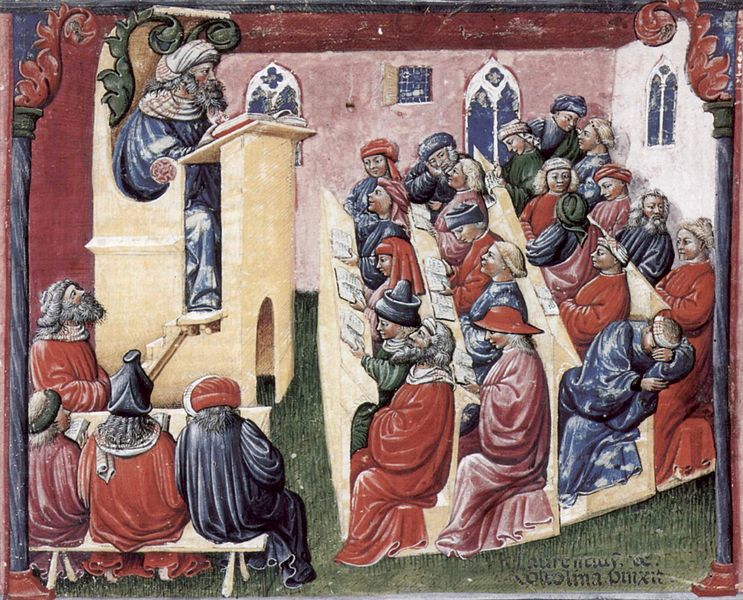
But the phrase 'Education is a right not a privilege' made me pause for another reason.  'Privilege' is a loaded and many-layered term.  In a medieval context it was repeatedly used in relation to universities, but with a quite different sense.  'Privilege' effectively meant 'private law' - it indicated that those who benefitted from it were not subject to the same laws as every else.  This was about a kind of exemption.  Medieval students had clerical status, which meant that they were subject only to ecclesiastical courts. These courts were much more likely to reach favourable verdicts on their misbehaviour, and were unable to impose corporal punishment (though they could hand the students over to other bodies for this purpose).  The result was that students acquired an appalling reputation - it seemed to townspeople that students could literally get away with murder - they could (mis)behave however they liked with almost complete impunity.  This wasn't quite the case, but it certainly stoked town-gown tensions so that they periodically erupted with terrifying violence.

This sense of 'privilege', of course, isn't what is meant today.  But it's useful to think about.   'Privilege' in the medieval sense means exemption from the normal rules - 'right' can (or should) bring with it a sense of integrity, inclusiveness and equal opportunity.  Fundamentally, 'privilege' in its medieval sense means 'setting apart'; 'rights' remind us that we're part of a society.  Everyone should have access to opportunities which enable them to stretch their brains and open up new horizons, and everyone should acknowledge the social inclusiveness and responsibilities which this brings.  If education is about rights, this is both because we value the individual, and because we see it as fundamental to a healthy social body.

Monday, 13 October 2014

UNIVERSITY FEES

At the workshop at the German Historical Institute last week, one of the participants asked me whether I'd been inspired to work on the topic of student violence by the issue of fees.  Being a total idiot, I misheard and thought he said 'feasts' - and given that I don't attend that many raucous feasts, the answer was no.

Anyway - when I realised what he'd actually said - I remembered some material from the archives in Dubrovnik on the subject of fees.  Medieval Dubrovnik seems to have been a city with a particular regard for education, and the importance not only of basic literacy, but of fairly widespread learning. Schooling here was quite widespread, literacy levels were high from a surprisingly early date (thirteenth century at least), and the quality of secondary education was fine.  But Dubrovnik (known at that stage as Ragusa) didn't have a university, so the city council sent promising young men abroad to study - to Paris or Padua in particular.

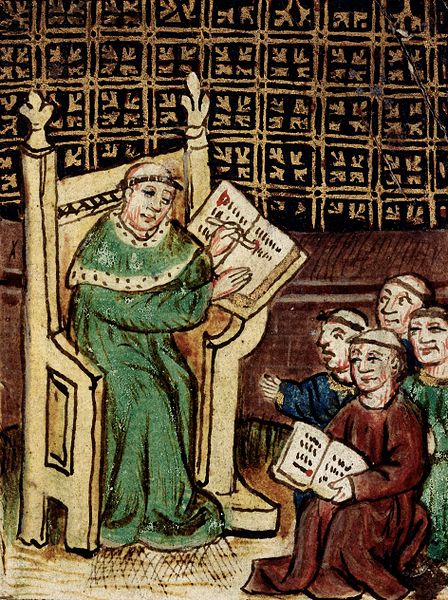
Detail of a master and scholars from Gautier de Metz 'L'image du monde', 1464.  source: http://prodigi.bl.uk/illcat/ILLUMIN.ASP?Size=mid&IllID=44150 (British Library, Catalog of Illuminated Manuscripts)

For example, in 1455, the council gave 60 hyperpers to the Dominican friar Donatus, in order that he could pursue his studies in Paris (Consilium maius vol. 10, fol. 152v).  In 1463, a patrician young man was given a grant to study in Italy (Consilium maius, vol. 12, fol. 138v).  Some families were obliged to make huge sacrifices to send their children to university: in 1463, a commoner was given permission to sell some of his lands in order to support the studies of his son (Consilium maius, vol. 12, fol. 183v).  Some young men seemed to see the promise of study as a good wheeze to extract money, because the council began to put in clauses to ensure that payment of the grant would only be forthcoming on completion of the degree (eg. Consilium Maius, vol. 13, vol 26r), or refuse to pay money until the student was actually on the boat to university (eg. Consilium Maius, vol. 13, fol. 147v).  

All this reminds us just how expensive university study was in the Middle Ages - and just how limiting such costs could be.  Why was the city government prepared to support young students financially? - presumably because it was felt that these young people would be able to give something back to the community, and certainly by the fifteenth century, it was felt that those with a university education could more effectively serve the growing bureaucratic needs of state.  In other words, I'm cynical enough to think that the number of financial grants to students rose because education could increasingly be given a price.

Set this beside the growing sense nowadays that university education is increasingly commodified - it's treated as a commodity with a commercial value, whose financial cost represents an investment for a greater return at some future point (an excellent article by Stefan Collini on this here) - and everything begins to look quite regressive.  The commodification of university learning is sad, intellectually constraining and misplaced in my view. But the Dubrovnik material gives a slightly more positive perspective in indicating how a fully-fledged sense of respect for the value of education can open up opportunities; more importantly, it introduces a sense of accountability and responsibility which hopefully means something more than just handing essays in on time!

On the Dubrovnik material, I recommend Krekic's 'The Miscellanea from the Cultural Life of Renaissance Dubrovnik' in his Dubrovnik: A Mediterranean Urban Society (1997)

Tuesday, 7 October 2014

WELCOME (BACK)!

It's the third day of 0th week today ( strange Oxford nomenclature), and really nice to see familiar student faces returning and new students arriving.  We're all really looking forward to getting to know them all and to enjoying many lively discussions together!


I've just returned from a conference in Strasbourg, so I also have a 'back-to-school' kind of feeling, one sharpened by a long and tedious plane journey.

Interestingly, it was the journeys to university which seem most to have stimulated the imagination of poets and story-tellers interested in student life in the Middle Ages.  We have very few fictional accounts of life in the medieval university, but quite a lot of texts surviving describing the adventures befalling students on their way to study. 
Chaucer's Reeve -
image  anonymous (http://sunsite3.berkeley.edu/hehweb/EL26C9.html) [Public domain], via Wikimedia Commons

Famously, Chaucer's Reeve's tale tells of two students from the north of England, who study at Cambridge, and visit a nearby village to see the wheat being ground.  They trick the greedy Miller and sleep with his wife and daughter.  Chaucer probably got the story from an Old French version called, Le Meunier et les deux clercs’  which in turn seems to have come from an Old Dutch original; there's also a Middle High German version,  Students were quite notorious, and when they were on their way to or from university, they reputedly made their presence felt in pretty irritating ways. 

There's a whole genre of Middle High German stories known as Studentenabenteuer which tell of the mischievous shenanigans which students got up to on their way to university - the stories have lots of sex, quite a lot of violence, and are often very funny.  In Zeierlei Bettzeug by der Schweizer Anonymous, a travelling scholar tries to stay with a peasant en route, but the peasant just says: ‘ein grossen furz lies er do/ und sprach zuo dem schuler also;/ ‘schuloer, das ist das bette din’ (‘He let off a huge far and spoke thus to the student: ‘Scholar, that’s your bed’): the student, though, has the last laugh, as he leaves a huge pile of poo for his host to slip in the following morning.  Sophisticated stuff.  The moral of the tale is: ‘wer spottet, des sol man spotten’ – ‘he who mocks/ takes the mickey/laughs last, laughs longest’.  In Claus Spaun's, Funfzig Gulden Minnelohn, a young man travelling to university spends all the money his dad has given him on a night of passion with a woman in a town he is travelling through – idiotically, he tells the husband about this the following day, who surprisingly enough gives him back his money, chastises his wife, and tells the student ‘darumb bis nummermer so gech,/ wann willeicht es geriet dir nit also’ ‘ don’t be so stupid next term/ you might not be so lucky again’(364-5).

And in reality, journeys to university were potentially very dangerous.  In 1310, a certain Salomon le Breton claimed that he had been stripped and robbed on his way to the University of Paris, and violently abused.

So I'm glad that our students are all safely here!


Thursday, 28 August 2014

WOMEN AT ST JOHN'S

St John’s College is currently celebrating ‘2000 WOMEN’: in October 2013, the 2000th woman matriculated to study here.

I was asked to produce a little sound-bite to celebrate this: you can see it here.

It wasn’t quite the appropriate context (nor did I have enough words) to say that, as far as I can see, there were actually three ways for women to be involved in medieval universities:

1/ as patronesses (Margaret of Anjou, one of the foundress’s of Queen’s College, Oxford, claimed the establishment was for the ‘laud and honneure of sexe femenine’)

2/ as prostitutes

3/ as launderesses

And sometimes as nos. 2 and 3 together.  So not only were women excluded, but they reduced and objectivised in pretty basic ways.

Margaret King has pointed out that there were a few female humanists in the fifteenth century, but they tended to be daughters of prominent humanists, educated by their fathers.  Given the desired celibacy of medieval university masters, even this informal educational opportunity was denied to women in university towns.


I would love to be able to find ways in which women could be informally involved in university learning in the Middle Ages, but I fear that this is unlikely.  So, I will reiterate my sound-bite: women, now is your moment!


Wednesday, 27 August 2014

MISBEHAVING STUDENTS

As we gear ourselves up to greet the new academic year, now seems an appropriate moment to post something about the misbehaving students of the past...

You can find a podcast of a lecture about this here.

I'm happy to say that the students whom I teach are a million miles removed from the stuff I study in the fifteenth century.  But the message that the derogatory labels and stereotypes can stimulate and exacerbate the kind of behaviour they apparently condemn is still relevant I think.

Saturday, 29 March 2014

Christminster

I've just finished reading Jude the Obscure by Thomas Hardy.  I'm working my way through Hardy's novels mainly because we spent so much time in Dorset last summer: the sense of place and way in which the landscape acts on the individuals is very striking in Hardy's writing.


Jude the Obscure is depressing and dispiriting and quite astonishingly horrific.  Much of the plot revolves around the idea of what constitutes true marriage, and the place of sex within it - I was pretty struck to find such frank discussion of sex in a book published in 1895.  The multiple tragedies of the plot are shocking and awful beyond words really - and Hardy seems quite deliberately to avoid encompassing the full horror in language, offering only short and abrupt accounts of the climactic moments.

Despite the romantic and familial tragedies which hit Jude, in a sense it's his own unrealistic aspirations which utterly destroy him.


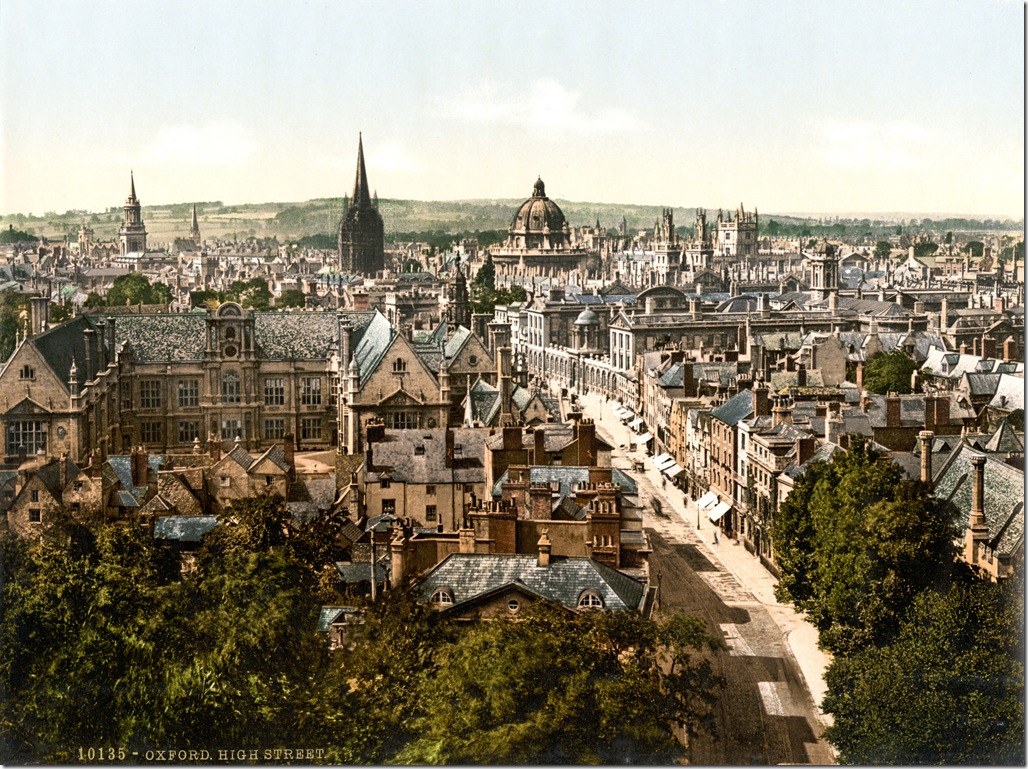
As a child, he becomes obsessed with the idea of studying at 'Christminster' - a university town, very much like Oxford.  For Jude, it's a highly romantic place - characterised by the eminence of a tradition of learning stretching back to medieval times, the peace and tranquillity of lives dedicated to the pursuit of learning, the centuries-old architecture a moving witness to the intellectual achievements which have happened within its walls.  But those very walls, on which he ends up working as a stone-mason, symbolise his exclusion - for no other reason that his social status and background.  The reader knows, with a sense of pathetic inevitability, that Jude's hopes and dreams, and endless nights spent self-teaching, are utterly in vain.  And not only does this make a tragedy of Jude's life - it makes a mockery of learning and all it apparently stands for.

'He always remembered the appearance of the afternoon on which he awoke from his dream. Not quite knowing what to do with himself, he went up to an octagonal chamber in the lantern of a singularly built theatre that was set amidst this quaint and singular city. It had windows all round, from which an outlook over the whole town and its edifices could be gained. Jude's eyes swept all the views in succession, meditatively, mournfully, yet sturdily. Those buildings and their associations and privileges were not for him. From the looming roof of the great library, into which he hardly ever had time to enter, his gaze travelled on to the varied spires, halls, gables, streets, chapels, gardens, quadrangles, which composed the ensemble of this unrivalled panorama. He saw that his destiny lay not with these, but among the manual toilers in the shabby purlieu which he himself occupied, unrecognized as part of the city at all by its visitors and panegyrists, yet without whose denizens the hard readers could not read nor the high thinkers live.'

Oxford.  Image credit: http://psychogeographicreview.com/?p=2014


This all made for quite uncomfortable reading for me, happily ensconced in the honey-coloured quad of St John's.  I truly don't think that the same comments could be made of Oxford today - but the danger is always there that we become so absorbed in tradition and self-congratulation, that we fail to ensure that the university offers opportunities to as many as possible, regardless of background; in welcoming people to the university - to research, to learn and to teach - all our own minds are opened by the insights and contributions which come together.  And this is why study days for A-level students, like the one we held last week, are so important - so thanks to everyone who came!

Monday, 24 March 2014

The streets of Paris


The other purpose of this trip to Paris was to get a sense of the space used by students when misbehaving in the fifteenth century.  My project is a comparative one, looking at Oxford, Paris and Heidelberg.  Then, as now, these were three very different cities, and exploring the different ways in which students engaged with the urban space in which they found themselves, provides some useful points of contrast.

The buildings in Paris have, for the most part, changed dramatically since the fifteenth century.  But a lot of the street layout in the Quartier Latin, where the students lived, remains remarkably similar.  I have found quite detailed accounts in the archives of how students negotiated their way around the streets and squares, and used the different connotations of particular areas to give meaning to their mischief.  


So, for example, we learn that in 1470, one Master Hugues Angot was woken from sleep in his hostel in the Rue des Noiers (now absorbed into the Boulevard Saint Germain) by loud and insulting singing outside his window.  Unable to sleep, and unable to endure the insults to his masculinity, and knowing the perpetrators to be old rivals, he roused his friend and they both went out into the street in their nightgowns.  They walked as far as the corner of the Rue des Anglais, but couldn’t see their disturbers, so they went back inside to get dressed properly.  Then they went out again, and saw their enemies at the end of the rue du Plastié (now rue Domat).  Unwilling to confront them directly, they passed on to the Place Maubert, a small square lined with student hostels and brothels.  Then they decided to take the long way round back to their hostel to avoid being spotted by their enemies and to avoid provoking a fight.  So, they passed by rue des Lavandières, then Rue des Noiers, then the Rue des Anglais.  Then turning down the Rue du Plastié again, they returned to their hostel via the Rue Saint Jacques.  But, just as they were returning to their hostel, they saw their enemies coming from the Rue des Anglais.  At this point though, some other people appeared, so the aggressors fled to the corner of the Rue des Closbrimeaux (now Rue Jean-de-Beauvais).  The men who’d been woken then chased their enemies until the Place Maubert, where they caught up with them outside the tavern des Trois Haches.  At this point the insulting singer tried to hit Hugues Ansot on the head, but Hugues defended himself with a stone, and the man was killed.
 

Not realising this, Hugues returned to his hostel.

At least this is the account which Hugues gave in his appeal for remission for murder.  Self-consciously trying to justify himself, he referred to space in very particular ways.  Retracing the steps of these students gave me a real sense of the importance of space.  Strategically, the students moved between the great open space of the Rue Saint Jacques and the overcrowded, dark spaces of the narrow streets of the Quartier Latin.  And symbolically, they moved between the public spaces of the city and the spaces of student and university life – they were making points about their integration into the life of the city, about the defence of their honour.  The real sense of their movements, the scary nature of events, the way in which their actions were shaped by, and shaped, the space around them – felt very different as I walked along the cobbles. 


Friday, 21 March 2014

In the archives

I’ve just returned from a wonderful trip to Paris (thanks to Frédérique Lachaud and the séminaire Franco-Britannique for the invitation) and this seems like a good moment to try to start posting again on the blog… sorry for the massive hiatus!

As well as getting some great feedback on my work on fifteenth-century student misbehaviour from colleagues at the seminar, and spending some time showing my son and husband my favourite spots in Paris, it was an opportunity to go to the archives and gather some more material on the fifteenth-century University of Paris. 


I always get a little anxious before these trips that so much of the material I work on is published and available in wonderful and scholarly editions, that it is hardly worth looking at the originals.  This is emphatically not true!  Every trip reminds me that there is so much still to discover (a trip to Heidelberg over the summer was crucial in discovering that the Acta universitatis, the main records of the university, continue for years after 1451, the end date of the published edition), and, of course, there are often inaccuracies in the published editions.  

But going to the archives represents something more than this I think – something more intangible.  It’s partly to do with a sense of historical imagination – holding a 600 or 700-year-old document in your hand gives a sense of connection with the past which is inspiring.  It’s partly to do with getting a real sense of the size, quality and format of the documents to underline the purpose they were designed to serve.  And it’s also to do with the fact that these aren’t just documents with text – they’re objects in their own right.  In many ways, some of them were even historical agents of sorts.  The point was brought home to me particularly forcefully when I was working in the archives in Lille in northern France some years ago.  I was looking at evidence for a revolt in Saint Omer in 1306, and found that the rebels were much inspired by a letter written to them by a famous Flemish rebel named Peter Coninck (who had led Flemish weavers to victory in the Battle of the Golden Spurs) – whilst the letter provided inspiration for its recipients, it was discovered by their enemies who used it further to discredit them.  The letter itself became almost fetishized – it ceased to matter what it said in it – it was fought over and talked about and grabbed and stolen – the letter itself came to symbolise the protest and the struggle.  To see the document itself then, was to see not just a document which told me about the revolt, but something which had been part of the revolt itself.  A much more comical example is that of a quittance or receipt sent to the Count of Artois in the late 13th century – - it was sent from the court jester, known as ‘Fromage’, and the rather disgusting remains of his seal – a punning bit of cheese – linger greasily on the parchment.  Another example of a document which was something much more than a piece of writing – it was part of a historical process, a joke.
  

Wednesday, 9 October 2013

TERM STARTS

Term is getting started, and it's a great treat to meet the incoming students and to see our second and third years again.  I must confess to being quite nervous about fitting everything in this term - it will be a challenge, but an exciting one I think.


Managing childcare during term-time is a particular challenge, as the flexibility of my research-time whilst the students are away is now a thing of the past.  And I'm struck by the number of comments from the rich and famous about how they face exactly the same problems.  I'm sorry - but they don't.  Having vast financial means makes things different.  Having the possibility of providing everything for your child makes things different.  And whilst I'm in a completely different world from these celebrity mothers, I should not pretend to be remotely facing the same problems and challenges which confront those in deprived parts of society.  It's nice to try to empathise, but I think it's not just misleading but regressive.

Victoria Beckham apparently recently commented: 'I'm basically just like any woman who's working and has lots of children - it's tough'.  Of course she isn't.  And she can't possibly know whatit's like to work because you have to financially, to struggle to afford childcare as well as working, to rush from pillar to post so that you're in the right place at the right time.  By suggesting that she does understand, she minimises the problems faced by many other mothers, and draws a veil over the need for change.  I can't possibly understand the challenges faced by mothers in many of the poorer parts of Oxford, and it would be insulting to claim that I can.  We need to acknowledge the vast inequalities before we can do anything about them.

I was also irritated by an article in the Guardian a while ago, claiming that Kate Middleton would face the same indignities during childbirth as everyone else.  This is idiotic.  Having the best medical attention that money can buy, a private suite, and the support of a loving family is not the same as giving birth without medical help on an earth floor somewhere.  I have personal reasons for feeling particularly strongly about this, given some pretty appalling medical care I received when having my own son - glossing over this and suggesting that we're all in it together is profoundly unhelpful.  It's a way of pretending that social and economic divisions don't meaningfully matter, and an insidious way of claiming that we don't need to do anything about them.

In the Middle Ages, there was certainly very little suggestion that the rich could empathise with the concerns of the poor, and nor were there attempts to claim that royals were 'just like us really'.  Social inequalities in the Middle Ages were truly appalling, but refusing to gloss over the gaps was a first historical step to acknowledging them, and, centuries later,to attempting to do something about them.  It will be very sad if we now fall for the pretence that they don't exist after all.

Monday, 29 July 2013

STEREOTYPES

As my students know, I'm rather wedded to the idea of criminological labelling theory! It's a ridiculous mouthful - but the idea behind it is very simply: that if you repeatedly label someone as deviant, or stupid, or even exceptionally successful, then that person is more likely also to behave in that way.

Liber ethicorum by Henricus Alemannia, late C14th
It first struck me in the context of the classroom before I even started studying history, that if you repeatedly label a particular child as naughty and deviant, you create a situation wherein that child can only really affirm his or her identity by misbehaving in such a way. The obvious riposte is that such labels don't tend to arise in a vacuum.  People generally label others because they have misbehaved in the first place - but, I think, the case still stands, that you do thereby shape the ways they're likely to behave in the future.  

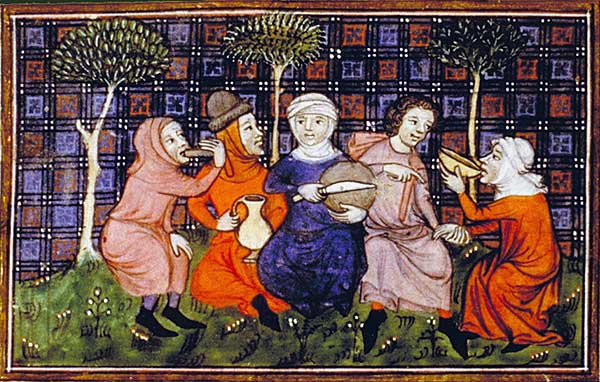
I've found it a rather useful way of thinking about the misbehaviour of students in the Middle Ages, the topic of my current research project.  These students were constantly being stereotyped by those around them as noisy, drunken, brutal and sexually immoral.  And certainly a noisy minority behaved in precisely such a way.  But surely this misbehaviour was shaped by the fact that the perpetrators knew that they were being constantly categorised as deviant.  In a sense, the choice of behaviours open to them was limited by the railing of preachers, parents, chroniclers and so on.  And sometimes, the students responded in quite explicit ways to the stereotypes.  My favourite example is a naughty student who signed off a letter requesting money from his guardian with the words 'From one who eats well, drinks better and sleeps the best': he was cleverly mixing the negative stereotypes with the language used to describe a model student.  We can then begin to analyse the particular gestures of naughty students by thinking about how they might, ironically, have been encouraged in their often very imaginative use of violence, by the very comments which sought to condemn it - they seemed often to take a certain pride in their actions.

I was therefore particularly interested to read in The Spirit Level that stereotyping students and children has been shown to directly affect their academic performance: they cite a study by Jane Elliott, a schoolteacher in the 60s, who told her students that it was scientifically proven that blue-eyed children were more likely to succeed than their lazy brown-eyed counterparts - sure enough, the children then fulfilled this prophecy in the test she set them; when she then informed them that she'd got the thing muddled up, and actually it was blue-eyed children who were lazy, the results dramatically reversed.  Wilkinson and Pickett comment that 'When we expect to be viewed as inferior, our abilities seem to be diminished' (p. 113).

The effects of stereotyping can't explain all underachievement and misbehaviour, but the historical evidence, as well as these more recent sociological studies, indicate that the ways in which talk about others carry a big responsibility.

Friday, 17 May 2013

GOOD LUCK

This is just a very quick post to wish all finalists (and indeed A-Level, IB and GSCE students) the very best of luck for their exams.


Our history finalists begin next week, and I'm sure that they'll all be great. But the message I'd like to convey right now, is that they have all already proved themselves.  A History degree is as much about participation and engagement throughout the course, as it is about performance on paper at the end.  All my students have been really wonderful to work with - challenging and debating, and providing new insights and perspectives for all of us.  So I can congratulate and thank you all before you've even started your exams.

Wednesday, 15 May 2013

REPUTATION AND VICTIMHOOD

Residents of Oxford are currently reeling at what is emerging in the trial of the appalling child abuse ring based in what can seem like a rather tranquil and certainly very privileged city (don't be taken in though - Oxford has one of the largest wealth differentials in the country).

Reading Zoe Williams' commentary on this in the Guardian today, I was particularly struck by her critique of the repeated excuse that 'no one quite put the whole picture together'.  As she says, the assumption here is that one girl's testimony was not enough.  And why was it not enough for one victim to claim that she had been sexually abused?  Because of the reputations of these girls.  Williams explains: 'Victims were considered unreliable because they'd run away, because they were challenging, maybe they were drunk or on drugs when the rape occurred'.

It is frightening to be forced to acknowledge that the credibility of victims is still considered to be dependent essentially upon their good name, let alone to consider that their 'bad reputations' are often indicative of the lack of social choices open to them.  

In later medieval England, 'reputation'  was actually enshrined in law as a key element of prosecution.  One's standing as a witness depended upon reputation, one's role as a juror was officially dependent upon 'good name', the credibility of victims was shaped by what was already known of their behaviour and standing within the community, and, of course, perpetrators could be found innocent or guilty on the basis of reputation.  This was not seen as problematic - it was in the nature of the law.  And in some ways, it can even be seen as a rather positive aspect of medieval law in action: it meant that communities, from a bottom-up perspective, were actively involved in the prosecution of law and in shaping legal outcomes.

But it doesn't take much to see the problems with such an approach.  


Strangers in communities were faced with almost automatic demonisation, the process of law became deeply prejudiced against those unpopular for other reasons, and the marginalised or disempowered within communities became ever more so, as their damaged reputations ensured legal persecution.

Clearly, lessons are to be learned from the 21st-century Oxford case, and I sincerely hope that one of them will be to assess complaints and testimonies of victims on their own merits, without the assumptions shaped by prejudice and stereotypes.

If you're interested in questions of medieval gossip and rumour, look at Chris Wickham's  'Gossip and Resistance among the Medieval Peasantry', Past and Present, 160. (1998).  And if you want to know more about the medieval English legal system, see Anthony Musson Medieval English Law in Context (Manchester, 2001).