Showing posts with label What is history?. Show all posts

Wednesday, 11 November 2015

LATERAN IV

Today is the anniversary of the opening of the Fourth Lateran Council (see earlier post).  It's a massively significant moment, whether one's interested in the history of law, the history of the Church, the history of persecution, of anti-semitism, and of the Crusades.

From the conference page for the Rome Concilium Lateranense IV commemoration conference (http://lateraniv.com/)

We tend to assume that anniversaries are there to be celebrated or at least that they are about commemorating sacrifices which have protected and enabled our own liberties - this is obviously the dominant narrative about Remembrance day, and, in many ways, rightly so.  But embedded in these kinds of narratives tends to be quite a self-congratulatory sense of progress - which could, perhaps, be usefully questioned.

Lateran IV is, I think, quite useful in raising these kinds of questions.  The extent to which Innocent III was able to extend the reach of a more-or-less uniform canon law is quite incredible.  The growing systematisation of the Church as an institution amounted to an enormous set of achievements.  And the extension of the pastoral reach of the Church was surely an indication of a more intense concern for the individual spiritual lives of western Christians.  But Lateran IV was also the moment at which distinctive clothing for Jews was prescribed, more stringent and brutal responses to heresy codified, and the dogma of the Church articulated through law and brute force.  What's so striking is that these extremely unpleasant developments were not the flip-side of the more positive achievements - rather they were intertwined, and embedded within them.

When we try to tease out the more uplifting bits of history, we often do a disservice to the present by rejecting the uncomfortable and dangerous complexity of reality.

Wednesday, 28 October 2015

On Anniversaries

It's a bumper year for Anglophone medievalists.  We have Agincourt (600 years) and we have Magna Carta (800 years).  Both have become emblematic historical moments, and there's a lot to be gained from thinking carefully and publicly about these events - in the case of Magna Carta, commemoration challenges us to think about the place of the law today, in some ways less and less accessible because of the erosion of legal aid.


But I think the most interesting anniversary is that of the Fourth Lateran Council.  This was the Church council convened by Innocent III in 1215 which did so much to streamline the role of the Church throughout Europe.  Its implications stretch way beyond the history of the Church - it was the point at which a big impetus was given to the persecution of heretics; marriage, baptism and confession were codified; the idea of Purgatory was formalised; canon law (the law of the Church) was imposed more uniformly across Europe.  The net effect of these impulses (I withhold judgement on the extent to which they were actually practised) was to systematise and to streamline the ways in which people were to think about religion and law.

There's much to admire in the Council, and much to find terrifying.  Innocent III himself was the figure who had responded to the French king Philip II, who wished for a marriage annulment, with the words: 'We have an immoveable mind, and an immoveable intention.  Not by prayer, not by price, not by love, not by hate, shall we swerve from the path of righteousness.  We shall walk the royal road.  We shall not deviate to the right.  We shall not deviate to the left.  We shall make judgements without taking up persons.'  This was about law as a system.  There were to be no favouritism, no bribes, no exceptions.  It's surely a critical moment.  Innocent was also the figure who pronounced Magna Carta null and void as soon as he possibly could.  None of these anniversaries are unambiguous.

Innocent III, from the Grandes Chroniques.  Source: wikimedia

I wonder why we are so much more willing to remember Agincourt and Magna Carta (and Waterloo), than something like Lateran IV.  My first instinct was to assume that this is essentially nationalist (in the broadest sense).  But (since nostalgia is so often on my mind at the moment), I wonder whether Agincourt and Magna Carta are more appealing because they lend themselves to romanticisation - both look like the victory of the weak over the mighty.  The outnumbered English soldiers and the courageous barons, make for edifying David and Goliath type stories.  I can't think of a way to romanticise Lateran IV - Innocent III was powerful, determined and unassailable.

Sunday, 25 October 2015

AGINCOURT

Today is the 600th anniversary of the battle of Agincourt.

From the Chronicle of Enguerrand de Monstrelet. Source: wikimedia

Last weekend, I was privileged to speak at a day of lectures on the context and battle of Agincourt.  I had been a bit wary of the activities organised to commemorate the battle, but what made this day so effective, and what has made many of the lectures, exhibitions and activities organised by Agincourt600 so valuable, is the thoroughly nuanced approach which has been adopted.

Part of this has involved detailed research on the numbers of men fighting, wounded and killed; on the weapons used; on the provisioning of the army; and on the siting of the battlefields.  This has been done by examining indentures, inventories, quittances and so on - rather than relying on chronicle accounts where more or less hidden agendas can prove very distorting.   Anne Curry's new book on Agincourt is particularly effective here.  The result is to illuminate what remains an extraordinary battle, but to become more respectful of the suffering involved, and the sheer logistics of the operation.

Part of this has involved setting Agincourt in a far wider context:  the political factionalism in France, arising in the main from a king suffering from paranoid schizophrenia who often believed he was made of glass; the rise of the House of Lancaster in England, with its mighty dynastic ambitions; and the staggeringly talented Henry V.  Malcolm Vale spoke on Henry V, and drew a portrait of a king immensely courageous and skilled at battle strategy, but also pious, concerned for Church reform, careful (he wrote many wills), cultivated and a workaholic.  It all serves to remind us that whilst we might pick out one historical moment, the reality was far more richly textured.  Military activity was one thread in a weave of political instability, economic interests, diplomacy and social dislocation.

Memorial for the battle. Source: wikimedia


And perhaps most strikingly, rather than simply contributing to the myth of Agincourt, the commemorations have shown how this myth arose.  Such is the particular strength of Anne Curry's new book - why has Agincourt in particular achieved such a pre-eminent place in the popular imagination?  Shakespeare is often held responsible for the image of the good king Hal, and the defeat, against all the odds, of the French.  But of course, Shakespeare is a great writer precisely because his work resists a single reading.  He challenges us because he shows that life is an entangled web of perspectives, where easy judgements can mask infinitely complex realities.  And this seems a fitting way to think about Agincourt.


Wednesday, 21 October 2015

WRITING ABOUT VIOLENCE

I'm writing an article for the BBC History magazine - it looks at whether our stereotypes of the brutal Middle Ages are justified.  Where do these stereotypes come from?  They are at least reinforced by popular culture such as Game of Thrones.  In the name of research, I subjected myself to five minutes of Game of Thrones last night - the violence is horrific.  I couldn't take any more.  Perhaps the most effective and eloquent summing up of the trope is the beyond-words brutal scene in Pulp Fiction, where one of the characters tells us that he's 'getting medieval on your ass'.  It's probably a bit pathetic of me, but I really can't deal with such gruesome scenes.

source: wikipedia


Where does this leave me as a historian of violence?  In some ways, it makes me feel very hypocritical - maybe I'm just not so upset by reading about violence in the Middle Ages because it feels less real.  But in other ways, it's salutary.  It reminds me that I should be upset.

The first lesson of the historian's craft is objectivity.  We're not supposed to impose our own prejudices and judgments.  The second lesson of the historian's craft is that complete objectivity is impossible.  Being aware of our own prejudices and judgments makes us much more reliable historians.  And the third lesson of the historian's craft, the one I was reminded of last night as the Game of Thrones  violence made me gag, is that some judgementalism and emotion is right and proper.  What's the point of studying what happened in the past if we don't have a sense of right and wrong, of what is humane and what is inhumane?  And part of this is about retaining respect and pity for those we're reading and writing about.  It's really easy to get inured to stuff we read about in the distant past, but this is to lose a sense of humanity and blunts the point of what we're up to.

Tuesday, 29 September 2015

Why 'do' history?

I have neglected this blog for a shamefully long time - a result quite simply of teaching and family commitments.  Research has been squeezed in, but 'extras' have been squeezed out.  Anyway - thanks to the incredibly generous Leverhulme foundation, I  am now entering a period of two-years' research leave.  Leaving teaching behind temporarily is a bit bitter-sweet, as I find our students truly inspiring. But this is an incredibly liberating opportunity, and I'm very exciting about having the time to follow all kinds of threads and traces through the library and archives.

Glimpses of the past at Winchester Cathedral
I'll be doing my best to write the blog regularly again - and now seems a good moment to remind myself of why we do history.   I think that, in all honesty, my sense of what history is, and why I do it, is an ever-changing thing.  At the moment, I'm particularly struck by histories of concepts - nostalgia, enough-ness, ownership, balance (on which there's an extremely sophisticated new book by Joel Kaye).  Concepts like these, which aren't necessarily rooted in particular terms, can all too easily seem trans-historical and self-evident.  This is one reason why we need historians - to think through the implications, resonances and boundaries of such concepts over time - to acknowledge that 'enough-ness' for example is contingent on economic and social contexts. Exploring change over time in this way isn't necessarily to say that these concepts are entirely relative, but it is to challenge our own often very complacent assumptions.  

In 1979 (in the American Historical Review), William Bouwsma, described 'an anthropological vision ... that culture is a product of the creative adjustment of the human race to its varying historical circumstances rather than a function of universal and changeless nature, and the perception that culture accordingly differs from time to time and group to group'.  So here's something for me to aim for!

Wednesday, 8 October 2014

DYNAMICS OF SOCIAL CHANGE AND PERCEPTIONS OF THREAT

Last week I went to a rather wonderful workshop at the German Historical Institute in London.  I was talking about my misbehaving students in Oxford and Heidelberg in the fourteenth and fifteenth centuries, but the conference as a whole was about 'Dynamics of Social Change and Perceptions of Threat', and part of a much larger interdisciplinary research project based at the University of Tuebingen.


The conference organisers had big questions for everyone: 'Under what conditions and in what manner threats may lead to a reconfiguration of values, structures of authority, responsibilities and resources.  Under which circumstances and in which way will an initially short-term reconfiguration of values, competencies and resources cause in wake of a perceived threat accelerate social change - or: under what conditions and in which manner will the old order be re-affirmed and restored, assuming that this is possible?'

I'm not sure that there exist answers to these questions in quite that form - but they are important questions to ask.  Conflict studies is a burgeoning field, and it's clearly very important to ask why conflict happens.  But one of the puzzles for students of the Middle Ages (and I imagine for modern historians also) is that conflict usually achieves *so* little - it's hard to see why people are prepared to risk so much.  When I was working on late medieval revolts in northern France, I was struck by how many of them achieved precisely nothing - and yet, nearby towns would quickly follow their example, only to be greeted with violent and horrible retribution.

The St Scholastica's Day Massacre in fourteenth century Oxford was horrifically violent, and, interestingly enough, it was pretty much the last event of its kind.  For the students (or at least for those who survived) it was rather a successful episode.  The revolt began when two students hit a tavern-keeper over the head with a tankard, accusing him of watering down the wine.  Three days of violence and mutilation followed - in which townspeople gave as good as they got from the students - and the townspeople found themselves facing utterly disempowering repression.  They never really dared challenge the student body again.  But social change wasn't just brought about by the violence of the students - it happened because that violence was backed up by a web of royal support, legislative power and clever rhetoric.  In other words, the university authorities provided accounts of what had happened which effectively exonerated the students, explaining how they were victimised by the brutal and bestial townspeople, without actually denying that the students had been violent themselves.  It was a clever piece of rhetoric, which managed to maintain the sense that students could be violent and powerful, whilst also portraying them as wronged victims.  And it was that rhetoric which ensured that the town was punished, and the students empowered.

In the fifteenth century, the picture changed significantly, but that's another story.  What most struck me at this stage, was that the possibility of change doesn't depend only on the violence itself, but on the ways in which it is described, narrativised, appropriated rhetorically, later.  And if there's any lesson here, it's that we need to read accounts of conflicts against the grain, and to remember that the act of representation, of making a story of it, is itself a form of violence and certainly a form of power.


Saturday, 13 September 2014

SLAVERY 12 - CHALLENGES!

The wretched internet connection has been down for the past couple of days... so to the challenges below, I can now add technology.

This is slightly frivolous and probably too honest  – but appropriate since I’ve spent many hours now going through volumes which turned out to be completely irrelevant.

Challenges in the archives:

1/ staying inside – when the sky is blue and the sea is warm (though actually right now it's pouring with rain).

2/ the handwriting – I’ve never found reading medieval script easy, and this will always be a particular challenge for me.  Most of the notarial hands I’m reading at the moment are pretty neat and tidy though.

3/ the gaps.  There are so many things I’d love to know! – what happened to slaves once they were freed? What were conditions like once they were with their new owners? What work exactly did they do? How old were they? What were their lives like before being enslaved? Despite the richness of these archives, there is so much we can never know, or only speculate about.  Yesterday, I found an account of a young girl who was adopted - truly fascinating, but why was she adopted? what happened to her later? how did she feel about it? how did her adoptive father treat her? did she ever see her birth parents again? was she adopted because of the poverty of her parents? We will never know.

4/ the names – it’s difficult at the best of times to trace a given name through the documents, but harder still when the same person can be known by several names: eg. A slave called Obratus of Bosnia, also known as Radosclavus (Diversa Cancellarie, II, fol 102r)


5/ the quantity – there is so much fascinating material!  And I’ve just wasted six hours on completely irrelevant volumes. Ouch!

Wednesday, 10 September 2014

SLAVERY 11 - the archives

The archives in Dubrovnik are housed in the Sponza Palace.  Most the building seems to have been completed by 1312. The ground floor was used as a customs-house, the first floor was for social occasions, and the second floor was the mint and dates from 1520 according to an inscription.  The famous Renaissance arcade in front was probably also added in 1520, whereas the elaborate windows of the first floor date from the fifteenth century and are recognisably Venetian in style. Caravans to the Balkan interior gathered in front of the building.  The elegant architecture bears visual witness to the interconnectedness of Dubrovnik with much wider trade networks across the Adriatic.

Inside the archives...

The archival collection itself began to be systematically put together from a very early date.  From the thirteenth century, notarial practices became so sophisticated that it was possible to file the documents very carefully.  The keeping of the archives was re-codified as a state activity in the 18th century, at which point they reclassified the collection into 14 series.  In the nineteenth and twentieth centuries, much of the material was taken away to Vienna, returning to Dubrovnik in 1920 where it was re-inventoried and in 1952 relocated to the Sponza palace.  The importance of these archives for a sense of political identity was key.

This tells us something beyond how to access the documents we want: it testifies to the symbolic importance of such archives, and the ways in which documents can are not only shaped by the history of a place, but become part of the history of a place.The parchment (or paper) doesn't just communicate what happened - in many ways, it is what happened.

In the documents that I've looked at there is a real sense that these matter as documents, not simply for what they tell us.  The contract of a sale of a slave doesn't just communicate the sale - it stands as a symbol for perpetuity of that person's status.  Even so, there was anxiety that documents might be challenged, and for that reason, particularly after manumissions of slaves, we find a clause stating that any subsequent document which might be produced cannot invalidate the one in hand.  Documents were referred back to in order to respond to challenges and prove ownership, they were registered in different places (loose contracts were officially registered in the notarial register - eg. a sale of 1339 as a loose leaf, then copied carefully into the Debita Notariae 2 fol. 270r), they were lost and then found.

So in the archives,we find not only the record of history, but we are handling history - touching the material things which embodied relationships of such importance.


Tuesday, 2 September 2014

SLAVERY 4 - the originals...

I have spent the last couple of days looking through the 1280 to 1282 book of Debita Notariae – solicitor’s documents from medieval Dubrovnik.

Dubrovnik, image from wikicommons

Why bother when there is an excellent edition of much of this material published by Gregor Cremosnik in 1931? First, quite simply because he didn’t include everything, so there are all kinds of fascinating nuggets to discover by looking through the document itself.


Second, because reading an edited selection doesn’t give you a real sense of the nature of the document itself.  It’s partly just the thrill of holding parchment from the thirteenth century.  But it’s more than that.  It’s seeing how carefully each of these notarial records was transcribed – the script is immaculate, the items carefully lined and justified for clarity: these are the workings of an extremely efficient set of notarial practices – thirteenth-century Dubrovnik was clearly a well-run city.  And, most strikingly, it’s about seeing where the slave trade fitted into the general life of the city. Returning to the original document, we find slave contracts interspersed with records of land and building transactions, marriage contracts, debt recovery procedures.  Even some of the legal formulae are the same.  These people were being treated as commodities like many others.

On folio 34 recto of the first volume of parchment, we find a record of a land transaction undertaken by one Stancius Butiglarius on behalf of his mother.  She was apparently 'present and consenting' [presentem et consentientem] - this seems to be quite a common formula to describe the consent of women in transactions undertaken for them by their husbands, sons or fathers.   The very next case noted in the document is the sale of a slave called Radosti de Bosna to one Pasque de Pecorario.  She seems to have been sold by a pair of traders who crop up several more times in the same volume.  The slave was apparently 'present and consenting' [presentem et consentientem] to this transaction.  This is a standard formula in these sale contracts, and the moral obfuscation it represents is pretty chilling.  But what's so striking here is the way it directly mimics so many other forms of transaction - nothing, not the language, nor the script, nor the placing of the transaction in the manuscript, distinguishes these sales from the material concerns of everyday business.

Wednesday, 19 June 2013

'ONLY MADMEN ARE CERTAIN AND DECIDED'
(Michel de Montaigne, Essais, 1.26)
Anonymous portrait of Michel de Montaigne

Having reached the end of term, this seems like a good moment to stop and think about what I'm trying to achieve with this blog.  If I could meet anyone from the past, I think I would choose Michel de Montaigne.  His Essais are a companion through life.  And what I admire so much about Montaigne is his exploration of the idea of doubt.  Through what he writes, as well as the way he writes it, he challenges dogma and certainty, whilst retaining moral integrity - to be able to hold the two in tension should be, I think, one of the greatest goals of civilisation.

With Montaigne as my guide, then, what I'm trying to do with this blog is to challenge myself to doubt and to question.  And it strikes me that this is really why I study history.  The past does not hold any keys for the present, but it provides us with ways to challenge ourselves and to reveal disjunctions, discontinuities and hypocrisies in our ways of thinking and responding to current events.  In other words, it enables us to throw our dogmatic responses into critical doubt.

Montaigne certainly didn't 'invent' doubt though.  Medieval discussions of doubting Thomas, the figure who couldn't bring himself to accept Christ's resurrection and had to touch his wounds before he believed, are fascinating in this respect.
Christ and Doubting Thomas, between 1477 and 1482, from the Basilica of Santa Casa, Loreto

Thomas was referred to disparagingly by early medieval theologians – as an unbeliever, he was an embarrassment -  St. John Chrysostom, for example, described Thomas as ‘grosser and more materialistic’ than the other apostles, and cited him as the epitome of the weakness of human faith and the inadequacy of many Christians – Thomas’s faith was insufficient to convince him of the miracle of the resurrection, and he would only believe when presented with visual evidence. 

In the later Middle Ages though, Thomas was reassessed.  An increasingly positive conception of the role of the senses in the spiritual life, particularly encouraged by the materialistic preoccupations of a growing commercialism, re-validated the figure of Thomas as one whose faith was based upon empirical evidence, and whose concerns about the origins of knowledge were shared by medieval people, particularly merchants, struggling to get to grips with shifting environments.

Second, anxiety about the Docetist and Arian heresies which negated the corporeal aspect of Christ’s humanity, meant that Thomas’ emphasis on the physical body of Christ was particularly welcomed by the established church and orthodox theology.  Thomas became the model theologian.

But third, and most importantly, Thomas was increasingly cited as a model for believers – his own personal journey from unbelief to belief described as paradigmatic for the Christian experience.

Commentators, notably Bede, focused upon the etymology of Thomas’s name, claiming that it originally mean ‘double’ or ‘twin’, and explaining that this ‘doubleness’ lay in his twin personality as the sceptic and the believer.  It was Gregory the Great and his increased focus on the Eucharist and the body of Christ, who most enthusiastically established Thomas as a model to whom Christians could look as they addressed their personal experience of journeying spiritually from scepticism to faith, or from ignorance to understanding.  

I find it really quite inspiring that doubt was given such a positive write-up in the Middle Ages, a period so often dismissed as an era of darkness, intolerance and dogmatism.  The figure of Doubting Thomas was used to suggest that doubt and scepticism are common to us all, but not only that, they are epistemologically and spiritual useful - that is, they are attitudes which allow us to explore and critique and challenge in new and productive ways.

In the early fourteenth century, Dante wrote 'che non men che saper dubbiar m'aggrada' ('it pleases me no less to doubt than to know' - Inferno, XI, 93) - he is quoted by Montaigne, although Dante's point is slightly different as he is claiming that doubt and questions ultimately lead to greater precision.  But the sense of critical doubt is very similar.  Do not take anything for granted; challenge your preconceptions; examine incongruities and try to highlight discontinuities and hypocrisies.  That is just what I am trying to do in this blog.

If you're interested in Doubting Thomas, see Alexander Murray, Doubting Thomas in Medieval Exegesis and Art (Rome, 2006).

Monday, 3 June 2013

It was the bicentenary of Wagner's birth on May 22nd.  A lot of people hate him, and a lot hesitate to admit that they love his music.  I find it outstandingly moving, and have a couple of other rather bizarre reasons for feeling a particular interest: first because two of Wagner's operas are about medieval poetic contests (Tannhäuser and Die Meistersinger von Nürnberg), a subject which I'm doing some research on at the moment (and about which more anon); and second because one of my most fun and bizarre orchestral experiences was being one of six harpists for a performance of Das Rheingold in a rickety old barn on a large farm in Buckinghamshire.

Die Meistersinger, image credit http://www.roh.org.uk
He is a tricky composer because his music is so moving, and his personality so repugnant.  Music as an art form works by drawing us in, and involving us emotionally: this is very particularly the case with the Gesamtkunstwerk of Wagner (see here), whose music was deemed so emotionally powerful that people feared it could reduce them to madness.  The idea of being drawn into a particular mental landscape is an alarming prospect with someone so extravagantly anti-semitic as Wagner.

One of my greatest heroes is Daniel Barenboim, and I'm enjoying reading his conversations with Edward Said at the moment.  Barenboim has flouted Israeli taboos against playing Wagner on multiple occasions, beginning with a highly controversial encore in Tel Aviv where he conducted the prelude from Tristan and Isolde.  He has been outspoken and eloquent about what he is thus trying to achieve, in terms of reinterpretation, moving forward and refusing boundaries.

The debate is one which makes us think in broader terms about the role of the author/ composer/ artist.  Are we, as audience/ spectator/ reader, bound by the intentions of the originator of a piece of art?  Should we be passive recipients of pre-formed ideas?  I really don't think so.  I reckon that a piece of music doesn't really become music until it is performed and listened to; that a painting doesn't become art until someone sees it; that a book is not literature until it is read and internalised.  In other words, I think that we, as consumers of art, are part of the artistic endeavour and involved in the production of meaning.  Roland Barthes' famous notion of the 'death of the author' is claiming something similar: that the author is not one who determines meaning, but rather the viewers, readers or listeners.   

If this is right, then we can listen to, and enjoy, Wagner (and many others of dubious moral background) with a clean conscience.  Great art is constantly to be reinterpreted, given new meanings.  The poetic competitions which feature in the Meistersinger and Tannhäuser give us a bit of a clue here: they remind us that medieval literature was, in a sense, drama and spectacle.  It was performed.  It's easy to forget, since we are reliant on surviving written texts, but even into the late Middle Ages, this was a very oral culture.  Even texts which were written down were most often intended for oral performance.  And as they were performed, and re-performed, they were adapted and mutated according to the needs and interests of particular audiences.  These were texts which were constantly in flux, where the notion of authorship (though obviously central in the contests) was often lost amongst the multiple layers of performance and reception.

But not only does this allow us to listen to Wagner.  It reminds us of our responsibility as part of the creative process.  As readers, viewers, listeners - we are part of the creation of meaning.  One of my other great heroes is Michel de Montaigne, who in the late sixteenth century, tried to suggest new ways of reading through the construction of his Essais.  Through a complex writing style, frequent interpolations, and deliberate contradictions within the text, he successfully reminds the reader of his or her own responsibility - that the onus is on us to read pro-actively.

Montaigne's response to those who worry that Wagner's anti-semitism automatically accompanies his art would be the following:

'It's an indication that it hasn't been cooked properly, and a sign of indigestion, when someone regurgitates the meat that he's just swallowed.  The stomach hasn't done its job if it hasn't changed the appearance and form of what it's been given to cook' (Essais, 1. 26)

Friday, 31 May 2013


GLOBALISATION

Today, we're looking at medieval Europe from a global perspective in our tutorials. The fourteenth century is an intriguing period in this respect - often overlooked in our excitement at fifteenth century European exploration and discovery - fourteenth century Europe was characterised by increased contact with the Mongols (an alliance against the Turks was even mooted), trade routes stretching from Genoa to China, missionary activity across Asia and into China, pilgrimages and even some cultural exchange.


Fifteenth-century depiction of Alexander the Great flying (having explored the entire known world): Roman d'Alexandre, Ms.651/1486,Musee Conde, Chantilly, France


Global history is a relatively new phenomenon in the field of medieval studies. It does two things: it draws our attention beyond Europe and helps us to readdress our very Eurocentric vision; and it provides methodologies for thinking about interconnections and exchange across boundaries. The first of these is very difficult to achieve, primarily because of the enormous range of languages this requires of researchers. Which doesn't mean to say that scholars are not going to try to take up the challenge: the recent book by Giorgio Riello on cotton re-centres the story on India in the Middle Ages.

There is a third reason why it is important to look at medieval history from a global perspective. That is that such a perspective sheds new light on the history of ideas and identities: how Europeans understood themselves, and how they conceptualised difference. Europeans in the Middle Ages seem to have been quite aware that the world they inhabited was, in many sense, expanding. And travel literature was immensely popular. Increasingly, they were able to draw on empirical observation to see that their everyday surroundings were not universal, that this was a world characterised by diversity and different ways of doing things.

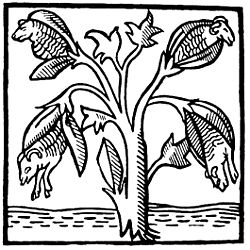
And yet, the ways in which they described those new discoveries and observations could only be done within familiar frameworks. Riello reproduces a particularly striking illustration from the Travels of Sir John Mandeville, an exceptionally popular fourteenth-century text, which describes, in highly imaginative terms, the wonders and marvels and monsters of the wider world.


This is, apparently, a cotton plant. 'There grew there [India] a wonderful tree which bore tiny lambs on the endes of its branches. These branches were so pliable that they bent down to allow the lambs to feed when they are hungrie.' What I love/ find troubling about this description and the image is the way in which Mandeville imaginatively recreates what is to him and his readers an utterly strange plant in terms of the familiar. In England, cloth production was of wool. So what better way to try to convey to his armchair readers this exotic Indian form of cloth production that in terms of a kind of weirdly contorted animal husbandry which allowed Europeans to understand the different in familiar frameworks, as well as creating an intoxicating sense of the monstrous and deviant?

I wonder how often, nowadays, media accounts of happenings in distant lands actually squash a more complex reality into familiar frameworks. And how often we allow genuine attempts to understand cultural differences to become overlaid with Eurocentric concepts which make the different automatically appear deviant.

Monday, 13 May 2013

HELLO THERE!

Hello!  I guess I ought to start by explaining why I'm bothering to write this blog...

I am fellow and tutor in medieval history at St John's College, Oxford.  I love my job, and fourteen months ago, I was blessed with a wonderful little boy.  It was a real wrench going back to work, and two weeks later, I became very ill and had to spend a long time in hospital - I'm lucky now to be alive.  All this has shifted my perspective somewhat.  Most of all, it has reminded me why I do what I do - and it was my brother's idea to try to express that on a day-to-day basis in a blog.  I'll be exploring how the perspectives and ways of thinking afforded by the study of medieval history can shape our reactions to current events and our sense of how we should behave in the modern world.  

This doesn't mean that I'm claiming we can straightforwardly learn from the mistakes of history, nor does it mean that history can be reified into some kind of edifying moral tale.  And I certainly reserve the right to say not particularly intelligent things sometimes!  

But the idea is that I will share my responses to current events, to books I have read (not necessarily medieval), and talk a little about the experience of being a working mum who loves and believes in her work, but misses being with her little boy the entire time!