Showing posts with label Reviews. Show all posts

Monday, 20 October 2014

OSCAR AND LUCINDA

I've just finished reading Peter Carey's Oscar and Lucinda, a marvellous sweeping book, which is both quirky and perceptive, horrifying and extremely funny - it's really quite unlike anything else I've read.

http://www.themanbookerprize.com/books/oscar-and-lucinda


Near the beginning, we are introduced to the character of Mrs Stratton, a late Victorian clergyman's wife, living a life of disillusionment and poverty.  Her husband went to Oxford - Mrs Stratton, obviously, didn't.

'Mrs. Stratton was not a don.  She could not have been, for while the constitution of the university would permit entry to a fourteen-year-old boy (with his pocket full of string and dried-out worms) it could on no account matriculate a woman.  Yet Mrs Stratton had the walk for it.  Her whole body expressed her calling.  She had a walk you can see today in Magpie Lane and Merton Street.  The dynamics of this walk are best appreciated if you place a three-foot-high stack of reference books in your imaginary walker’s extended arms.  From here on it is all physics.  You can resolve it with vectors – the vertical arrow indicating the mass of the books, the horizontal one the propulsive force of the moving body.  It is obvious.  You can see immediately why the body of such a person tilts forward at 60 degrees to the horizontal.  It is the books, or the propensity for books, that does it.  And when you see the height of the stack it is also clear why such people always lift their head so high.  You thought it was myopia, but no – it is the height of the imaginary books they must look over.'

It's an unkind description, although the narrator is not a gratuitously cruel one.  But the unkindness exposes the mistrust and antipathy towards women with intellectual pretensions.

Anyway - I hope I don't walk like this!

Monday, 7 April 2014

The Mayor of Casterbridge

More Thomas Hardy -  it's an enormous bedtime treat to hear such a distinctive voice creating landscapes of intense power and melancholy.

Woodcut for The Mayor of Casterbridge, source wikipedia


I began with Under the Greenwood Tree, because of my interest in harmoniums - on which more shortly. Next The Mayor of Casterbridge.  I don't intend to give away the plot, but what struck me most forcefully here was the amount of social mobility.  Michael Henchard, the eponymous hero, or anti-hero, begins the story as a lowly journeyman hay-trusser.  He rises to become a wealthy corn-merchant and the mayor of Casterbridge - he is at the top of the social tree in his community.  Of course, as so often with Hardy, decline and melancholy follow.  

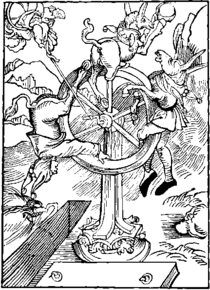
Wheel of fortune in Sebastian Brant`sNarrenschiff, woodcut by A. Dürer (wikipedia)

Based only on my stereotypes of rural nineteenth-century society, I was surprised to find that such social mobility could form a credible plot.  And this helps me looking back to the fourteenth century also.  It is so easy to assume that past societies were immobile, that hierarchies were fixed, and that social position was immutable.  I've certainly assumed this very often of the Middle Ages, and the 'true' stories of dramatic social rises are few and far between.  But by the fourteenth century, the wheel of fortune was an immensely popular literary and iconographical motif:  the idea of a great rise in fortunes, and the precariousness of any social standing, was something which resonated with people who felt both empowered and vulnerable.  If many were trapped in their positions, others had, dangled before them, the possibility of economic and social climbing - opportunities which worked both ways, as the commercially successful could also fall catastrophically.

From an edition of Boccaccio's De Casibus Virorum Illustrium showing Lady Fortune spinning her wheel (wikipedia)

It's useful to remember that few societies are as immutable as they appear - but that, much as politicians might like to focus on the upward trajectories, their very existence makes success all the more fragile: each success story so often masks a fall.

Saturday, 29 March 2014

Christminster

I've just finished reading Jude the Obscure by Thomas Hardy.  I'm working my way through Hardy's novels mainly because we spent so much time in Dorset last summer: the sense of place and way in which the landscape acts on the individuals is very striking in Hardy's writing.


Jude the Obscure is depressing and dispiriting and quite astonishingly horrific.  Much of the plot revolves around the idea of what constitutes true marriage, and the place of sex within it - I was pretty struck to find such frank discussion of sex in a book published in 1895.  The multiple tragedies of the plot are shocking and awful beyond words really - and Hardy seems quite deliberately to avoid encompassing the full horror in language, offering only short and abrupt accounts of the climactic moments.

Despite the romantic and familial tragedies which hit Jude, in a sense it's his own unrealistic aspirations which utterly destroy him.
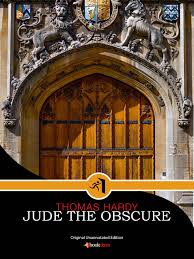


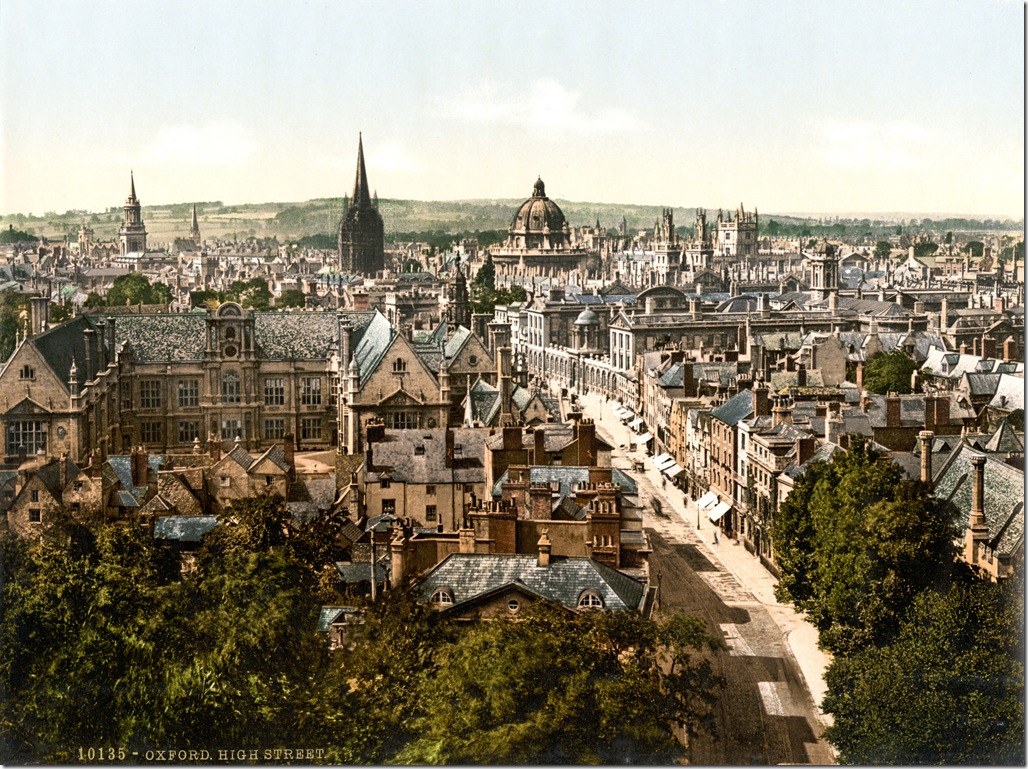
As a child, he becomes obsessed with the idea of studying at 'Christminster' - a university town, very much like Oxford.  For Jude, it's a highly romantic place - characterised by the eminence of a tradition of learning stretching back to medieval times, the peace and tranquillity of lives dedicated to the pursuit of learning, the centuries-old architecture a moving witness to the intellectual achievements which have happened within its walls.  But those very walls, on which he ends up working as a stone-mason, symbolise his exclusion - for no other reason that his social status and background.  The reader knows, with a sense of pathetic inevitability, that Jude's hopes and dreams, and endless nights spent self-teaching, are utterly in vain.  And not only does this make a tragedy of Jude's life - it makes a mockery of learning and all it apparently stands for.

'He always remembered the appearance of the afternoon on which he awoke from his dream. Not quite knowing what to do with himself, he went up to an octagonal chamber in the lantern of a singularly built theatre that was set amidst this quaint and singular city. It had windows all round, from which an outlook over the whole town and its edifices could be gained. Jude's eyes swept all the views in succession, meditatively, mournfully, yet sturdily. Those buildings and their associations and privileges were not for him. From the looming roof of the great library, into which he hardly ever had time to enter, his gaze travelled on to the varied spires, halls, gables, streets, chapels, gardens, quadrangles, which composed the ensemble of this unrivalled panorama. He saw that his destiny lay not with these, but among the manual toilers in the shabby purlieu which he himself occupied, unrecognized as part of the city at all by its visitors and panegyrists, yet without whose denizens the hard readers could not read nor the high thinkers live.'

Oxford.  Image credit: http://psychogeographicreview.com/?p=2014


This all made for quite uncomfortable reading for me, happily ensconced in the honey-coloured quad of St John's.  I truly don't think that the same comments could be made of Oxford today - but the danger is always there that we become so absorbed in tradition and self-congratulation, that we fail to ensure that the university offers opportunities to as many as possible, regardless of background; in welcoming people to the university - to research, to learn and to teach - all our own minds are opened by the insights and contributions which come together.  And this is why study days for A-level students, like the one we held last week, are so important - so thanks to everyone who came!

Thursday, 3 October 2013

Miraculous Images

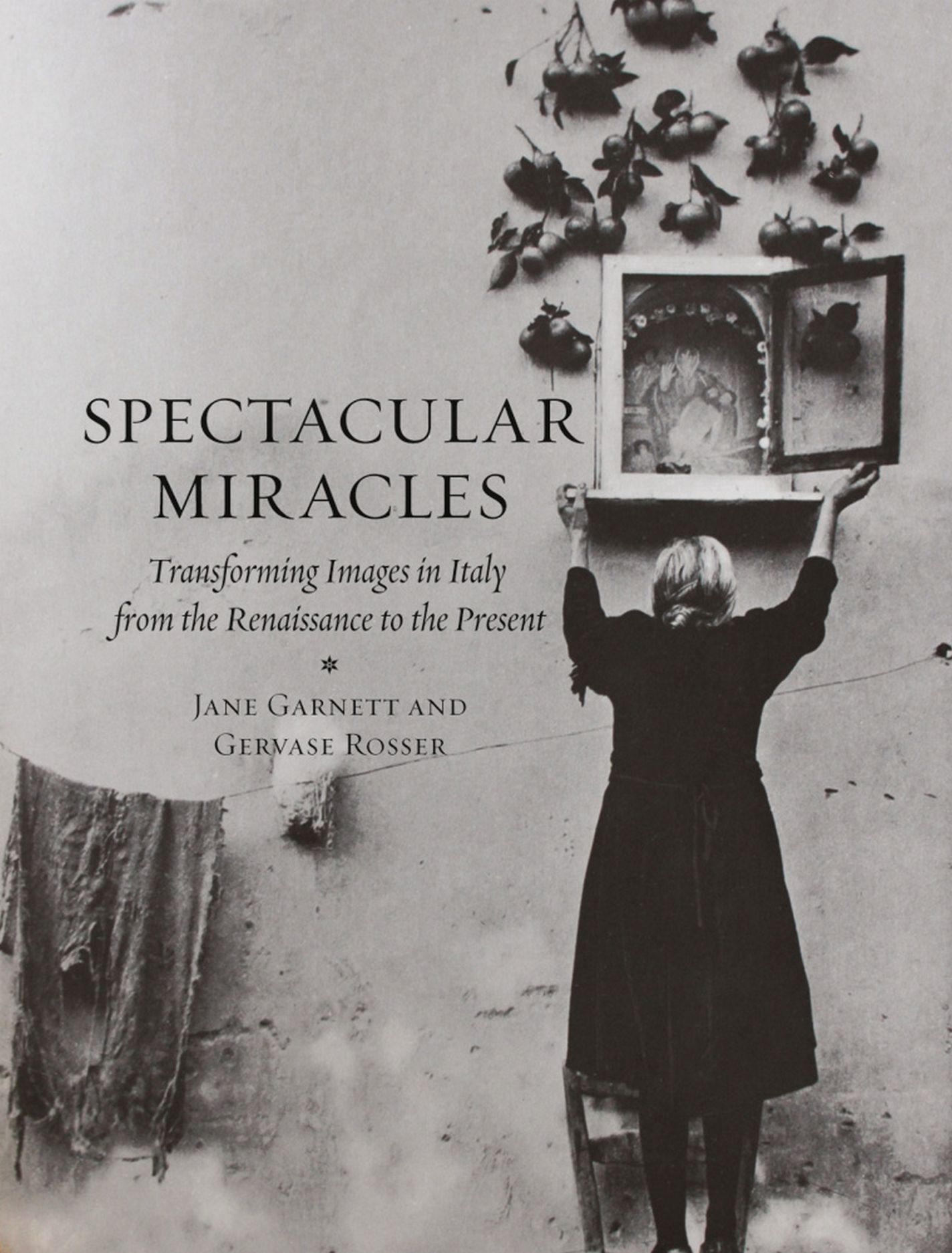
I've just finished reading Jane Garnett and Gervase Rosser's new book, Spectacular Miracles: Transforming Images in Italy from the Renaissance to the Present.


The book is about the history of images which were, and often are, thought to work miracles on behalf of their viewers.  The idea is such an intriguing one, and extremely prevalent, as Rosser and Garnett show, with some wonderful and very moving examples of miraculous images from medieval and modern Italy.  From an anthropological perspective, the images often seem to function as meeting-points of faith and community, of popular devotion and hegemonic prescriptions and, more often, proscriptions.

Most thought-provoking, I thought, were the implications for how we think about images.  Rosser and Garnett point out that many of these miraculous images have long been overlooked because it is perceived that they are unskilfully executed and of minimal aesthetic value.  But is art just about forming aesthetic judgements?  Or is it about thinking through the different ways in which the visual impacts on us?  Rosser and Garnett show very clearly that the latter, the dynamic relationship between an image and its viewers, is really the more compelling approach.  Images which are deemed kitsch, poorly executed, or cheaply produced can exert a powerful influence on their viewers.

When I was a teenager, I spent a lot of time wondering whether a painting shut away in a cupboard for noone to see, still counted as art.  The idea that art is something which enters into a relationship with its viewers is wonderful.  It doesn't just validate the paintings which have long been denigrated as being of low aesthetic value.  It validates the viewers.  This perspective suggests that viewers themselves must be active participants in the artistic process; that their reactions make something 'art'.  This is wonderfully liberating, and wonderfully egalitarian in its implications.  Art is not just produced by skilled artists, but by everyone who responds to it.  And this notion is taken to an extreme with the most original miraculous images, those described in Byzantium as 'acheiropoieton' - these were the images deemed not to be created by human hands, but by miraculous divine intervention - images which became 'art' as humans responded to their miracles.

Andres de Islas
Mexico act. 1750s-1775
Our Lady of Guadalupe (Juan Diego Shows the Image to Bishop Zumarraga) , credit figgeartmuseum.org, also shown in Garnett and Rosser, p. 35.
The proactive and creative role for the viewer which miraculous images imply also made me wonder about how we paint the act of viewing in words and pictures.  If viewing is itself something which participates in the artistic life of an object or painting, how to we depict that act?  It is really striking that there are lots of images of miraculous images, and lots of stories about the operation of images (my favourite is a tale by the C13th Gautier de Coinci, wherein an irate and jealous miraculous statue of the Virgin Mary punishes a young man for giving a golden ring destined for her to another woman).  These images and stories further underline the importance of viewing, since they take the viewers and their emotional responses as their subject.  But in depicting this in a story or piece of visual art themselves, they create the beginnings of a kind of infinite regress, which I'm now continuing by talking about images of images being seen.  It's a bit like endless hypertext commentaries on the act of reading, and it leads us deeper and deeper into the importance of human responses and the involvement of everyone in responding to, and creating, meaning.